
A few months ago, a client asked me which SEO tool they should buy. Simple question, right? Except every comparison article online reads like it was written by someone who’s never actually used the tools, just regurgitated feature lists from pricing pages.
So here’s what happened: I convinced three different clients to let me run Ahrefs vs Moz vs Semrush side-by-side on their accounts for six months. Same websites, same keywords, same link-building campaigns. The goal? Figure out which one actually delivers instead of which one has the prettiest interface.
The short answer: Semrush wins for most people. But Ahrefs dominates if you’re obsessed with backlinks, and Moz makes sense when budget screams louder than features. Keep reading because the “why” behind these picks matters way more than the conclusion.
Table of Contents
Quick Take: Stop Scrolling If You Just Need The Answer
Semrush – Best for 80% of SEO pros. Most complete toolkit, strongest keyword research, AI features that actually work. Starts at $139.95/month.
Ahrefs – Best for link builders and agencies managing multiple domains. Freshest backlink data, cleanest interface. The credit system is annoying, though. Starts at $129/month.
Moz – Best when you’re broke or just starting. Cheapest entry at $49/month. You’ll outgrow it, but that’s fine.
Now let’s get into why these picks make sense (or don’t) for your specific situation.
Pricing Story
Let’s start with money because that’s probably why you’re here.
Semrush Pricing
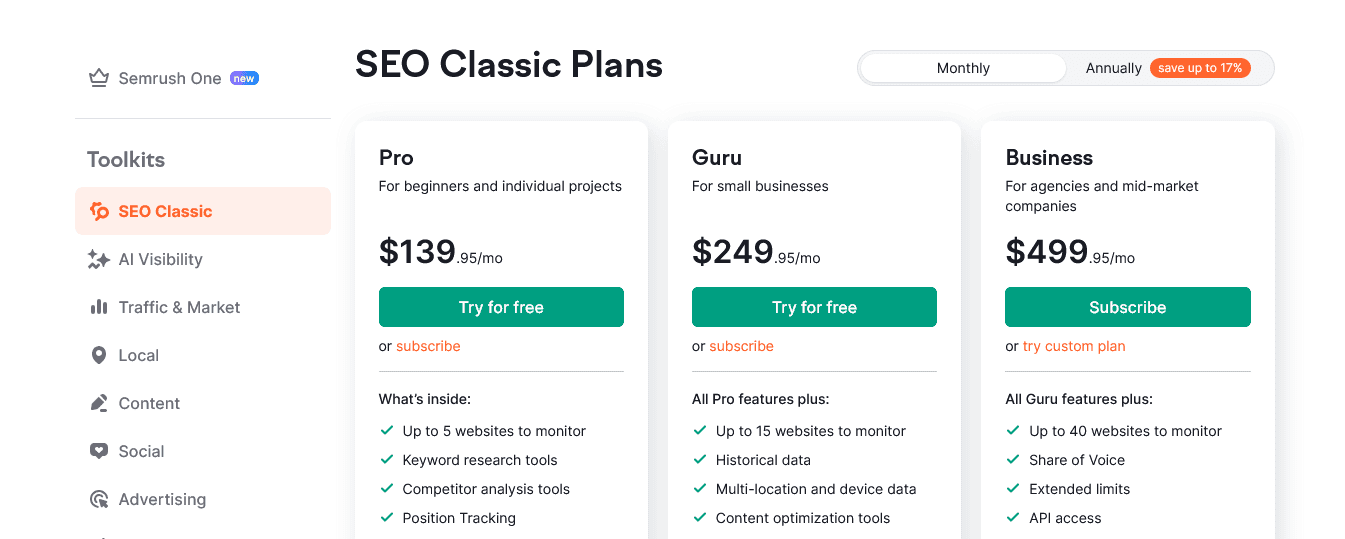
Monthly billing starts at $139.95 for Pro. But here’s the thing – nobody should pay monthly. Annual billing drops that to $117.33/month, saving you $271 per year.
Here’s the breakdown:
- Pro: $117.33/month (annual) – 5 projects, 500 tracked keywords
- Guru: $208.33/month (annual) – 15 projects, 1,500 keywords, Content Marketing Toolkit
- Business: $416.66/month (annual) – 40 projects, 5,000 keywords, API access
The Guru plan is the sweet spot. Pro feels restrictive fast, and Business is overkill unless you’re running an agency with 10+ clients.
Hidden costs: Additional users cost $80/month each. So if you’ve got a 3-person team on Guru, you’re actually paying $409.95/month, not $208.33. That’s a 64% jump nobody mentions in reviews.
Ahrefs Pricing
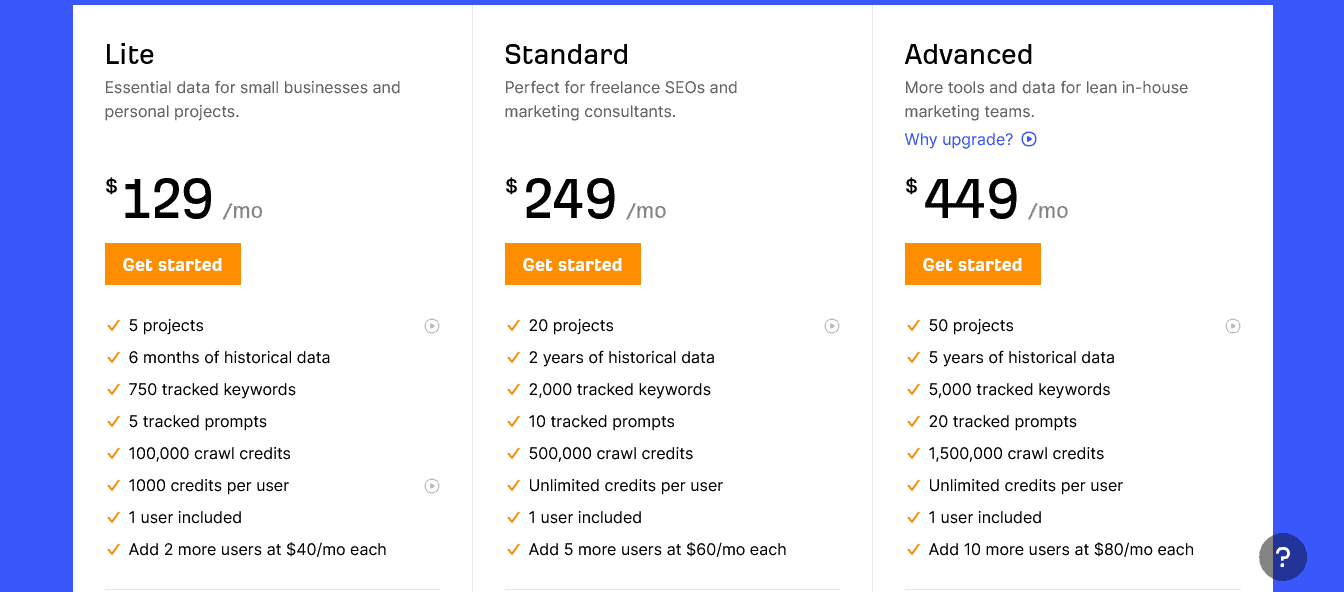
Ahrefs raised prices in April 2024 and pissed off the entire SEO community. Lite jumped from $99 to $129/month. No apology, no explanation.
Current pricing (annual):
- Starter: $29/month – basically useless, 100 credits only
- Lite: $108/month – 5 projects, 750 keywords, 500 credits
- Standard: $199/month – 20 projects, 2,000 keywords, unlimited usage
- Advanced: $399/month – 50 projects, unlimited everything
Here’s what nobody tells you about the credit system: every search, every report export, every damn filter you apply costs credits. Lite gives you 500/month. Heavy users burn through that in two weeks.
Standard unlocks unlimited usage (no more credits), which is why most pros end up there despite the $199 price tag.
No free trial. Ahrefs removed their $7 trial in 2022. You’re buying blind.
Moz Pricing
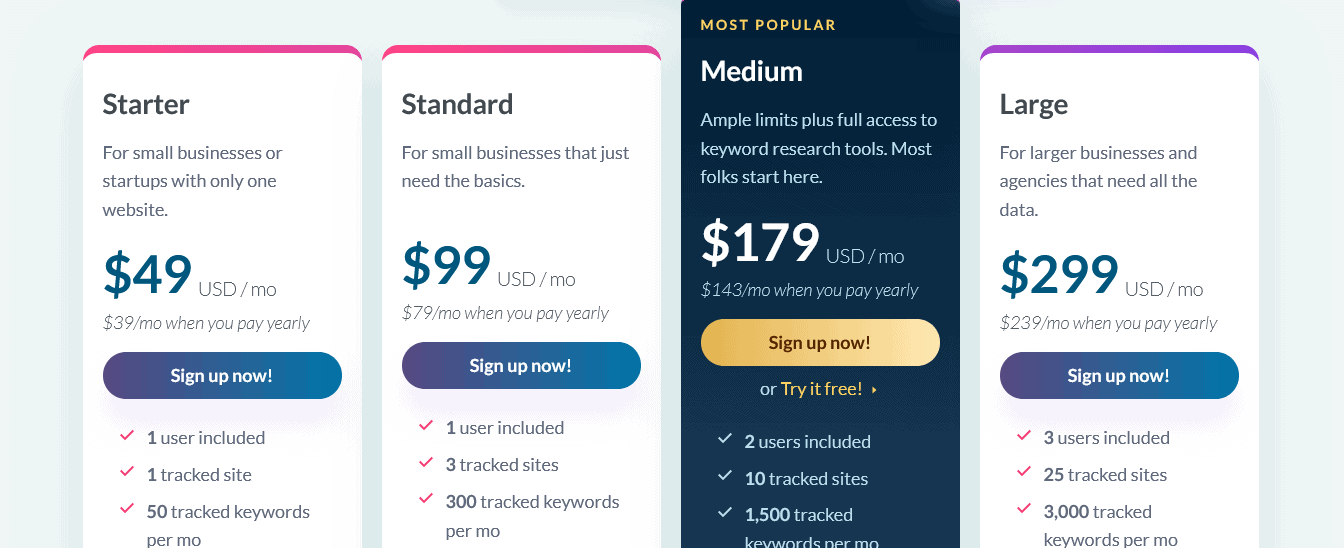
Moz is the budget champion.
- Starter: $49/month ($39 annual) – 1 site, 50 keywords
- Standard: $99/month ($79 annual) – 3 sites, 300 keywords
- Medium: $179/month ($143 annual) – 10 sites, 1,500 keywords
- Large: $299/month ($239 annual) – 25 sites, 3,000 keywords
At $49/month, Moz Starter costs one-third of Ahrefs Lite. Is it as powerful?
Hell no.
But for freelancers or small business owners just getting started, it beats spending $129 on features you won’t use.
30-day free trial on all plans. That alone makes Moz less risky than Ahrefs.
Keyword Research: Where You’ll Spend Most of Your Time
This is where the Ahrefs vs Moz vs Semrush battle gets interesting.
Semrush: Database Monster
Semrush sits on 27.9 billion keywords across 243 countries. That’s absolutely massive. For finding long-tail, low-competition keywords that other tools miss, Semrush dominates.
The Keyword Magic Tool shows search intent (informational, navigational, commercial, transactional), which Ahrefs barely touches. For content strategists, this classification is gold.
Tested example: Searched “AI content detectors” in all three tools. Semrush returned 1,847 keyword variations. Ahrefs returned 1,203. Moz returned 487.
Ahrefs: Accuracy Queen
Ahrefs crossed 20 billion keywords. Smaller than Semrush, but keyword difficulty scores are more realistic. Semrush sometimes shows keywords as “easy” that are actually brutal to rank for.
The Parent Topic feature clusters related keywords, which helps with topical authority strategies. This is genuinely useful when planning content hubs.
Downside: PPC and CPC data feel like an afterthought. If you run paid campaigns alongside SEO, Ahrefs won’t help much.
Moz: Lightweight Option
Moz has 500 million keywords. That’s 4% of what Semrush offers. For mainstream topics, Moz is fine. For niche long-tail research, you’ll hit walls fast.
The Priority Score combines volume, difficulty, and CTR into one number. Reduces decision paralysis for beginners, but experienced SEOs won’t trust a single metric.
Verdict: Semrush for depth and intent data. Ahrefs for accuracy. Moz, when you’re learning the basics.
Backlink Analysis: Make-Or-Break Feature
If you’re doing serious link building, this section matters more than anything else.
Ahrefs: Still The Champion
Ahrefs built its reputation on backlinks, and in 2026, that reputation is earned. The backlink index is the freshest in the industry – you see new links faster than competitors using other tools.
Crawl speed is unmatched. When a link goes live, Ahrefs typically picks it up within hours. Semrush? Days. Moz? Sometimes a week.
For anyone running active outreach campaigns and needing to know right now if that guest post went live, Ahrefs is non-negotiable.
Domain Rating (DR) is more operationally reliable than Moz’s DA or Semrush’s Authority Score. When presenting to clients, DR carries weight.
Semrush: Solid Second
Semrush’s backlink database is respectable but smaller. For most use cases, it’s enough. The Backlink Gap tool (shows which sites link to competitors but not to you) is actually better designed than Ahrefs’ version.
Authority Score incorporates backlinks, organic traffic, and spam signals. More holistic than DR, but less portable when explaining metrics to clients.
Moz: Playing Catch-Up
Moz’s Link Explorer has the smallest backlink database of the three. Domain Authority (DA) is widely recognized, but it’s also the most gamed metric. Sites with inflated DAs that don’t actually rank happen all the time.
The Spam Score feature is useful for filtering sketchy link prospects, but that’s about where the advantages end.
Verdict: Ahrefs wins backlinks hands-down. If 60%+ of your work is link building, this alone justifies the cost.
Site Audits: Finding What’s Broken
Every tool crawls your site and flags technical issues. But how actionable are those recommendations?
Note: if you run WordPress, CrawlWP fixes many of the on-page issues these audits flag, such as missing titles and meta descriptions, broken links that need redirects, missing schema and stray noindex tags, from inside your dashboard.
Semrush: Most Thorough
Semrush Site Audit checks for 170+ issues across technical SEO, on-page SEO optimization, and Core Web Vitals. The reports are detailed without being overwhelming.
Practical test: Ran audits on a 15,000-page e-commerce site. Semrush found 847 issues, clearly prioritized by impact. Fixed the top 20, saw 12% traffic increase within six weeks.
Ahrefs: Clean But Less Comprehensive
Ahrefs Site Audit checks around 120 issues. The interface is cleaner than Semrush, which some people prefer. Less clutter, faster to scan.
But “clean” sometimes means “missing stuff.” Semrush caught canonicalization issues that Ahrefs didn’t flag.
Moz: Decent For Small Sites
Moz crawls up to 2 million pages on the Medium plan. For small-to-mid-sized sites, that’s plenty. The recommendations are beginner-friendly, which helps teams without dedicated developers.
For enterprise sites with 50,000+ pages? Moz struggles to keep up with the level of detail that Semrush provides.
Verdict: Semrush for comprehensive audits. Ahrefs for speed and simplicity. Moz for smaller sites.
Rank Tracking: How Often Do You Need Updates?
This is where workflow preferences matter.
Semrush: Daily rank updates across desktop and mobile. You can track rankings by location (city-level for local SEO). The Position Tracking tool integrates with Google Analytics for traffic correlation.
Ahrefs: Daily updates, clean charts, mobile-friendly interface. Position history goes back further than Semrush (2+ years on Standard plan vs. 1 year on Semrush Pro).
Moz: Weekly updates on Starter, daily on Standard and above. For most people, weekly is fine. Rankings don’t shift that fast.
SE Ranking is also worth a look here. It tracks both traditional and AI rankings, so you can see how a keyword performs daily across organic Google search, as well as ChatGPT, AI Overviews, AI Mode, Gemini, and Perplexity.
Honest take: Daily updates sound important until you realize checking ranks daily drives you insane without changing anything actionable. Weekly works for 90% of situations.
AI Features: 2026 Arms Race
Every tool scrambled to add AI features. Some are useful. Most are gimmicks.
Semrush: Actually Shipping Useful Stuff
Semrush’s AI writing assistant integrates with keyword data, keeping suggestions grounded instead of generic. The most useful feature is AI Overviews visibility tracking – showing which queries now trigger AI-generated answers in Google.
For teams worried about AI eating organic traffic (which is everyone in 2026), this visibility is critical.
Ahrefs: Bolt-On Features
Ahrefs added an AI content grader and keyword clustering. Both are solid but feel tacked on. You open separate workflows to use them instead of encountering them naturally.
Moz: Lagging Behind
Limited AI-assisted meta description generation. Nothing substantial. If AI features matter to you, Moz isn’t competitive here.
Verdict: Semrush leads AI integration by a mile.
Truth About What Each Tool Costs
Let’s do real-world math because advertised prices are bullshit.
Solo freelancer scenario:
- Semrush Pro annual: $1,408/year
- Ahrefs Lite annual: $1,296/year
- Moz Standard annual: $948/year
Moz wins on pure cost. But if you need deeper keyword research or better backlinks, the $348-$460 difference might be worth it.
Small agency (3-person team) scenario:
- Semrush Guru + 2 users: $4,920/year
- Ahrefs Standard (single user): $2,388/year
- Moz Medium: $1,716/year
Ahrefs lets you verify unlimited domains without paying per-seat costs. For agencies, this is huge. Semrush’s per-seat pricing punishes team growth.
Enterprise scenario:
- Semrush Business: $5,000+/year
- Ahrefs Advanced: $4,788/year
- Moz Large: $2,868/year
At this scale, negotiate everything. Published prices are starting points.
Which Tool Wins For YOUR Situation?
Pick Semrush If:
- You need the most complete toolkit (SEO + PPC + content + social)
- Keyword intent classification matters for your content strategy
- You’re managing 5-15 client accounts
- AI visibility tracking is part of your 2026 strategy
Pick Ahrefs If:
- 60%+ of your work is backlink analysis and outreach
- You’re an agency juggling 20+ client domains
- You value clean UI and fast data over feature bloat
- Real-time link discovery justifies the premium price
Pick Moz If:
- Budget is your primary constraint
- You’re just learning SEO and don’t need enterprise features yet
- You want a 30-day trial before committing money
- Domain Authority is the metric your industry speaks
Don’t Pick Any Of Them If:
- You’re a hobby blogger with zero budget (use free tools first)
- You only need rank tracking (get a dedicated tracker for $20/month)
- You’re not serious about SEO (harsh, but true – these tools require effort to extract value)
My Personal Setup (What I Use)
Here’s what’s running on my computer right now:
Primary: Semrush Guru plan. I use it for keyword research, content gap analysis, site audits, and AI visibility tracking. Worth every penny of the $208/month.
Secondary: Ahrefs Standard for backlink analysis only. Yes, I pay for both. The $199/month is justified because Ahrefs backlink data is superior for outreach campaigns.
Occasionally: Moz’s free MozBar extension for quick DA checks when evaluating link prospects.
Total monthly cost: $407. Is that overkill? Maybe. But I bill clients $8K-$15K/month for SEO work. Tools are the cheapest part of the operation.
Common Mistakes That Waste Money
Starting on the wrong plan: Most people buy Pro plans and immediately need Guru. The $90/month upgrade feels expensive after already committing. Start one tier higher than you think you need.
Paying monthly instead of annually: You’re literally throwing away 16-17% by not committing to annual billing. If you can’t commit for a year, you’re not ready for the SEO tool.
Not using the features you’re paying for: Semrush Pro includes 10,000 results per report. If you’re only using 2,000, you’re wasting capacity. Either optimize usage or downgrade.
Buying tools before strategy: No tool fixes a bad strategy. Figure out what you’re actually trying to achieve, then buy the tool that supports that goal.
Real Winner Depends On Context
After months of parallel testing, here’s the truth: there’s no universal winner in the Ahrefs vs Moz vs Semrush battle.
Semrush is the best default choice for most SEO professionals. It’s the most complete toolkit, AI features are shipping fast, and keyword research is unmatched.
Ahrefs is the specialist’s tool. If backlinks and link building drive your work, nothing comes close. The premium price is justified by data quality.
Moz is the entry point. It’s not the most powerful, but it’s affordable and beginner-friendly. You’ll probably outgrow it – that’s fine. Start here if $129/month makes you nervous.
What matters more than the tool is whether you’ll truly use it. A $49/month Moz subscription that gets used daily beats a $249/month Semrush subscription that sits unused.
Start your trials (Semrush and Moz both offer them), run your actual workflows, and see which interface clicks for you. The “best” tool is the one you’ll open every Monday morning without dread.
Now, for real, stop overthinking and pick one already.
FAQs
Is Ahrefs better than Semrush for SEO?
Ahrefs wins on backlink analysis and data freshness – if 60%+ of your work is link building, choose Ahrefs. Semrush wins on keyword research depth, AI features, and all-in-one capabilities – for most SEO professionals, Semrush delivers more value. Neither is objectively “better” – it depends on your specific workflow.
Which is cheaper: Ahrefs, Moz, or Semrush?
Moz is cheapest at $49/month for the Starter plan ($39 annual). Ahrefs Lite costs $129/month ($108 annual). Semrush Pro costs $139.95/month ($117.33 annual). However, per-seat costs change the math: Ahrefs allows unlimited verified domains, while Semrush charges $80/month per additional user.
Does Moz have a free trial?
Yes, Moz offers a 30-day free trial on all plans. Semrush offers a 7-day trial. Ahrefs removed its free trial in 2022 and now requires immediate payment.
Which tool has the best backlink data?
Ahrefs has the freshest, most comprehensive backlink index in 2026. Crawl speed is unmatched – new links appear hours after going live instead of days or weeks. Semrush backlink data is solid for most use cases, but smaller. Moz has the smallest backlink database of the three.
Can I use multiple SEO tools together?
Yes, many professionals use Semrush for keyword research and site audits, plus Ahrefs specifically for backlink analysis. Combined cost runs $350-400/month but provides best-of-both-worlds capabilities. Only makes sense if you’re billing clients $5K+/month.
Which SEO tool is best for beginners?
Moz is most beginner-friendly with a simpler interface, better educational resources (Moz Academy, Whiteboard Friday), and the lowest entry price at $49/month. The 30-day free trial lets you test without risk. You’ll outgrow Moz as your skills advance, but it’s the best starting point.
Do these tools help with AI search and ChatGPT SEO?
Semrush leads with AI Overviews, which track visibility to show which queries trigger AI-generated answers in Google search results. Ahrefs added basic AI features, but they feel bolted on. Moz lags significantly on AI capabilities. For tracking visibility in AI-powered search experiences in 2026, Semrush is the clear winner.
Which tool offers the best ROI for agencies?
Ahrefs offers better value for agencies managing 15+ client domains, with unlimited verified domains at no per-seat cost. Semrush Guru ($208/month annual) suits agencies with 5-15 clients who need comprehensive SEO + content tools. Moz works for very small agencies managing fewer than 10 straightforward local or content campaigns.