
The SEO Framework alternative
CrawlWP: The SEO Framework alternative with indexing built in
The SEO Framework is the plugin for people who are not a fan of SEO plugins: no ads, no telemetry, sensible automatic output, and a settings screen that respects you. People look for a The SEO Framework alternative when they want the half of SEO that happens after you publish, or when the extension list stops being enough.
The short answer
Why people look for a The SEO Framework alternative
TSF users rarely leave over output quality. These are the three reasons they come to us.
It stops when the page is written
TSF generates excellent meta tags, and then its job is done. Nothing submits your URLs to a search engine, and nothing tells you whether they arrived.
Everything useful is an extension
Redirects, local schema, analytics fields, and keyword guidance are separate extensions behind the Extension Manager, which is another plugin to install.
No search data in WordPress
There is no Search Console panel for Google or anyone else. You go to the search engines’ own tools, which is deliberate, but it adds workflow friction.
On this page
Side by side
CrawlWP vs The SEO Framework, feature by feature
On-page output is close enough that it is not the deciding factor. What separates them is everything that happens after a page is published, and how the paid parts are sold.
| CrawlWP | The SEO Framework | |
|---|---|---|
| Works with no configuration | Defaults applied on activation | Fully automatic |
| Meta title and description templates | Free, editable templates | Automatic, with deep manual control |
| Bulk editor for titles and descriptions | Free | Not included |
| Schema and Open Graph | Free | Free |
| Breadcrumbs | Free | Free |
| LocalBusiness schema | Free | Local extension |
| Image alt text automation | Free | Not included |
| robots.txt editing | Free, pre-filled with live output | Free |
| llms.txt | Free | Not included |
| Redirect manager | Free: 301, 302, 410, regex | Per-post 301 only |
| 404 monitor | Free | Not included |
| Internal link automation | Keyword rules, Premium | Not included |
| Content analysis | Focus keyword checks, free | Focus extension |
| XML sitemap | Uses the WordPress core index | Its own sitemap |
| Google News sitemap | Premium | Articles extension |
| Video and HTML sitemaps | Premium | Not included |
| Multilingual sitemaps | Premium: WPML, Polylang, TranslatePress | WPML and Polylang compatible |
| GA4 and Tag Manager fields | Free | Cord extension |
| Import from other SEO plugins | Free, six plugins | Transport extension |
| Instant indexing | Free | Not included |
| Index status per post | Premium: Google, Bing, Yandex | Not included |
| 30-day index history | Premium | Not included |
| Search Console data in WordPress | Premium: Google, Bing, Yandex | Not included |
| SEO email reports | Premium | Not included |
| No ads or telemetry in the plugin | Yes | Yes, and an Incognito extension |
| How it is sold | One license, everything included | Free core, plus an Extension Manager subscription |
| Paid entry price | Starts at $59 a year | Extensions from about $7 a month, billed annually |
Being fair about it
Where The SEO Framework is the better choice
No The SEO Framework alternative beats it on principle, and for many developers that is the entire decision.
Privacy and principles
No advertising, no tracking, no upsell interruptions, and an Incognito extension that removes the plugin’s traces from your markup. If that is why you chose it, nothing here should change your mind.
Automatic output quality
Its generated titles and descriptions are unusually good with no configuration, and it handles edge cases most plugins get wrong.
Performance focus
Built with real attention to query efficiency. Independent benchmarks consistently put it among the lightest plugins available.
The extension model
You add only what you need rather than shipping everything to everyone. If you want two extensions and nothing else, you don’t pay for the rest.
Developer-friendly
Well-documented filters and a codebase intended to be extended. If you plan to build on top of your SEO plugin, this is the one.
Honest interface
Its inline guidance explains rather than gamifies. No traffic lights telling you to hit an arbitrary keyword count.
Where CrawlWP is ahead
Everything after the page is written
The SEO Framework is an on-page plugin by design, and it is a very good one. It does not submit your URLs to search engines, check whether they were indexed, or bring any search data into WordPress.
Instant indexing, free
Submission to Google, Bing, Yandex, Naver, Yep, and Seznam.cz as your content changes. TSF does not submit to any search engine.
Index status per post
Indexed, pending, or missing on Google, Bing, and Yandex, on the posts list you already use.
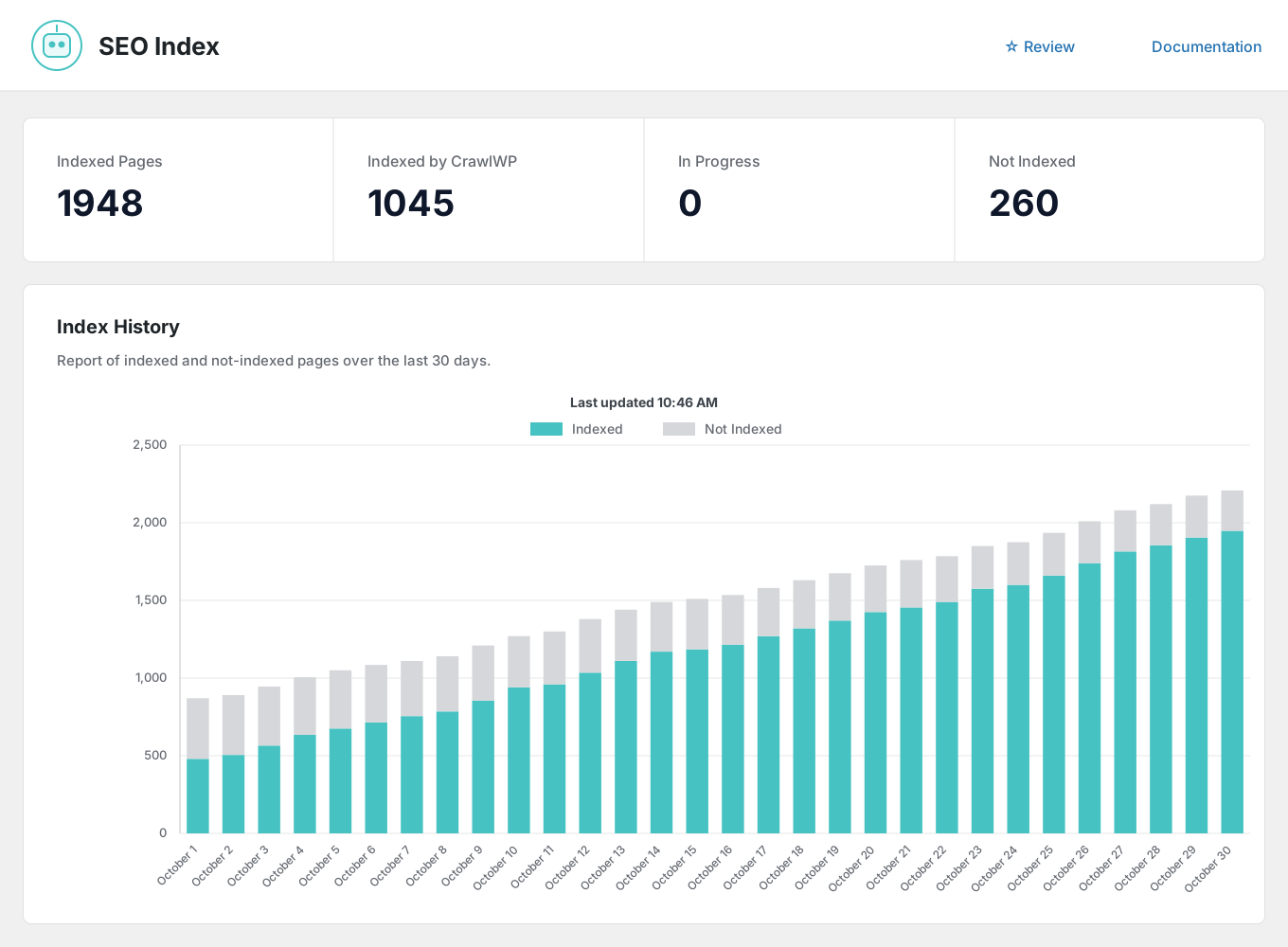
30-day index history
A chart of indexed and not-indexed pages over time so that you can see the trend rather than a snapshot.
A bulk editor
Change titles and descriptions across many posts at once, without opening each one.
Redirects and a 404 monitor
301, 302 and 410 rules with regex matching, plus a log of the URLs people are hitting that do not exist.
One licence
Redirects, sitemaps, schema, internal linking and indexing are in the plugin, not assembled from extensions.
The gap nobody else fills
Search data in WordPress, from three engines
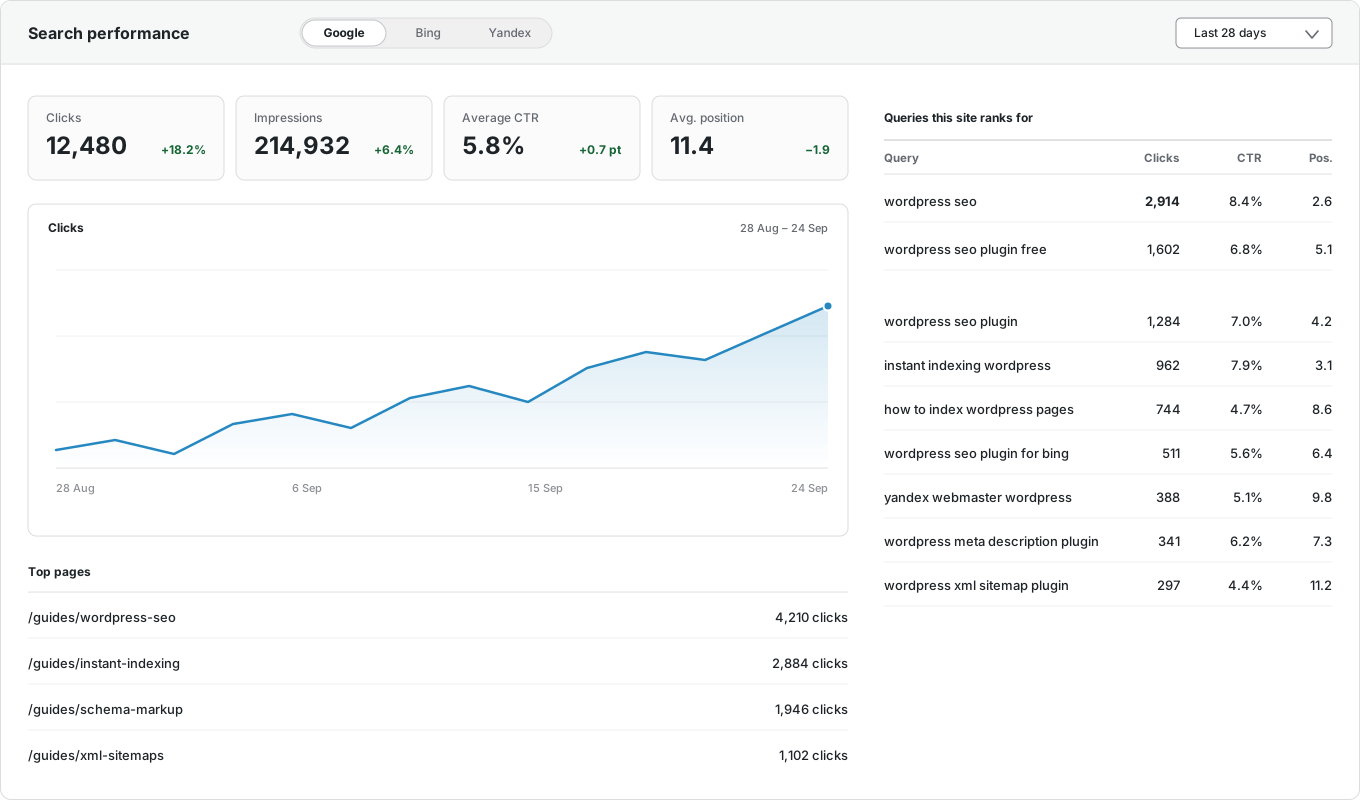
The SEO Framework does not report search performance inside WordPress at all, for any engine. That is a deliberate choice, not an oversight: the data lives in the tools that own it. If you would rather have it beside your posts, CrawlWP reads Google, Bing, and Yandex and reports all three together.
Google Search Console
Clicks, impressions, CTR, and average position, inside WordPress.
Bing Webmaster Tools
The same numbers from Microsoft Bing, on the same screen.
Yandex Webmaster
Clicks, impressions, ranking keywords, and positions from Yandex.
Per-post performance
Each post’s own numbers and top keywords, in the editor sidebar and the Insights tab.
Top pages and queries
Your best-performing URLs and the searches that bring visitors, with top countries and devices.
Your data stays yours
The numbers are stored in your own database, and the plugin has no advertising.
And it comes to you
The SEO report your client will actually read
Daily, weekly, or monthly, to as many recipients as you like, in your own brand color. The SEO Framework does not send a scheduled performance report.

Your schedule
Daily, weekly on a day you choose, or monthly.
Multiple recipients
Comma-separated addresses, so clients and colleagues get it without a WordPress login.
Search performance
Impressions, clicks, CTR, and average position, with the change from the previous period.
Indexing insights
Pages indexed on Google, pages likely indexed on Bing, and pages still not indexed.
Keywords and pages
The searches driving traffic and the URLs earning the clicks.
Recent movements
What was newly indexed and what was dropped since the last report.
Switching
Moving from The SEO Framework takes minutes
Install CrawlWP alongside The SEO Framework, import the titles, descriptions, canonicals, and robots settings it saved, spot-check a few posts, then deactivate it. TSF is one of the six plugins our importer detects. The importer copies rather than moves so that you can roll back. The full migration guide walks through it step by step.
Questions
CrawlWP and The SEO Framework questions
Answers to the questions people ask most when comparing the two.
Is CrawlWP a good alternative to The SEO Framework?
If you want indexing, index status, and search data inside WordPress, yes, because TSF does none of those by design. If you chose it for its privacy stance, its automatic output, or its filter API, it is still a good plugin for you, and we would rather say so.
Why switch from The SEO Framework?
For indexing and search data. TSF is an on-page plugin and does not submit your URLs to search engines or report performance inside WordPress.
Does CrawlWP track me or show ads?
The plugin has no advertising, and it stores your search data in your own database. We connect to Google, Bing, and Yandex on your behalf, which TSF deliberately does not do, so that is a real difference in approach rather than a claim of equivalence.
Does The SEO Framework do instant indexing?
No. It writes your meta tags and sitemap but does not submit pages to any search engine. CrawlWP submits to six in the free version and then checks whether each page was indexed.
Is CrawlWP cheaper?
It depends on how many extensions you need. TSF’s core plugin is free, and its Extension Manager subscription starts at about $7 a month billed annually. Our $59 a year includes everything, and we sell a lifetime license.
Can I import from The SEO Framework?
Yes. It is one of the six plugins the importer detects, alongside Yoast, Rank Math, All in One SEO, SEOPress and Slim SEO.
Which should I choose?
If you want the cleanest possible on-page plugin and you are happy using Search Console directly, choose The SEO Framework. If you want indexing, index tracking, and reporting across three engines without leaving WordPress, that is what CrawlWP is for.
Pricing
One license, no extensions to assemble
Every plan includes every feature. The difference is how many sites you can run.
Standard
For 1 Site
$59
/ year
Pro
For 5 Sites
$159
/ year
Agency
For Unlimited Sites
$259
/ year
Standard
For 1 Site
$359
once
Pro
For 5 Sites
$559
once
Agency
For Unlimited Sites
$759
once
Try it alongside The SEO Framework
Install CrawlWP, import what The SEO Framework saved, and compare the two for a week before you deactivate anything. There is a 14-day money-back guarantee either way.
yoursite.com
https://yoursite.com › guides › wordpress-seo
A Practical Guide to WordPress SEO in 2026
Learn how to structure, optimize, and index a WordPress site so search engines find your content within hours rather than weeks.
Google · indexed
Bing · indexed
Yandex · indexed