
Do you want to discover the top Google SEO ranking factors that can increase your website’s visibility and organic traffic in 2026?
Most website owners want to rank higher on Google, but with so many SEO tips and conflicting advice online, it can be difficult to know what actually works.
The truth is that Google’s algorithm is constantly changing, and strategies that worked a few years ago may no longer deliver results. But the good news is that some ranking factors continue to have a major impact and are worth your attention.
In this article, you’ll learn the 8 Google SEO ranking factors that matter most in 2026, why they matter, and how you can use them to improve your rankings and drive more organic traffic to your website.
Table of Contents
Understanding Google Ranking Factors
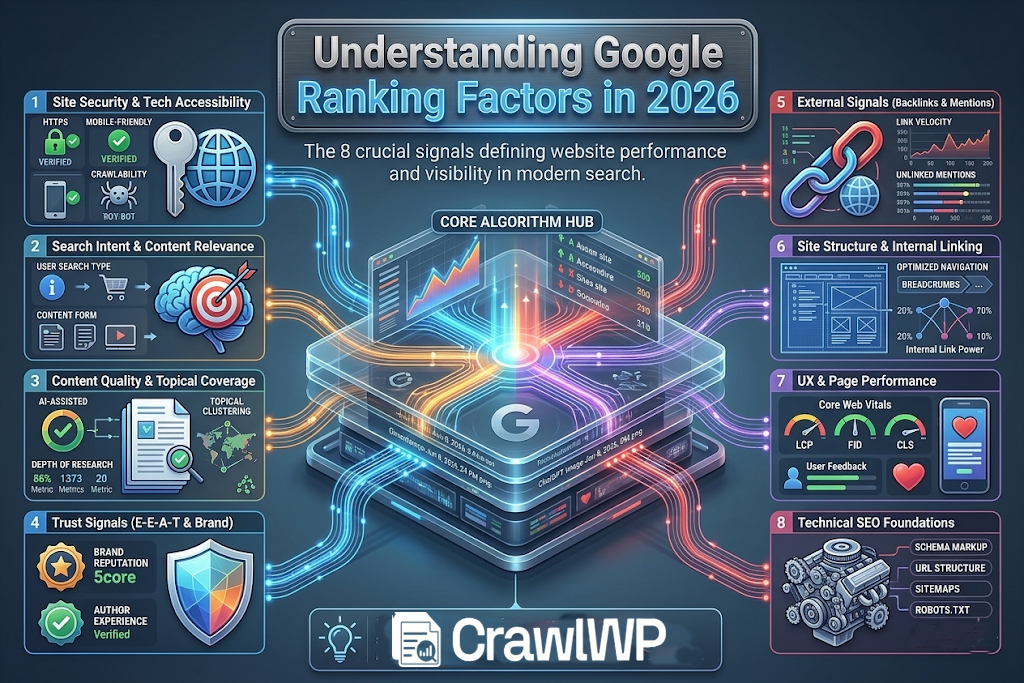
Google no longer ranks pages based primarily on keywords and backlinks. Those factors still matter, but Google’s systems have become significantly better at understanding context, user intent, authority, and overall content quality.
Modern search results are powered by multiple systems designed to identify the most useful page for a specific search query. Google’s guidance consistently emphasizes helpful content, page experience, and relevance rather than mechanical optimization techniques.
Think of Google’s ranking process like hiring the best person for a job. The search engine doesn’t look at only one qualification. Instead, it examines dozens of signals. A page may have excellent backlinks but poor content. Another may have fantastic content but terrible usability. The pages that perform best usually succeed across multiple areas simultaneously.
This is why many SEO professionals are moving away from asking, “What is the single most important ranking factor?” Instead, the better question is, “How can I create the best possible answer for the searcher?”
The websites that win in 2026 are those that consistently better satisfy user needs than their competitors.
With that in mind, let’s take a closer look at the Google ranking factors that matter most. While no single factor guarantees a top ranking, improving these areas can significantly increase your chances of earning better visibility, attracting more organic traffic, and staying ahead of your competitors.
Ranking Factor #1: Site Security and Technical Accessibility
Site security and technical accessibility are important because, before Google evaluates your content quality, backlinks, or authority, it first checks whether your website is safe and accessible. If search engines or users encounter barriers, your chances of ranking well will drop immediately, no matter how good your content is.
Site security is mainly about trust. The most visible part of this is HTTPS, which encrypts the connection between a visitor’s browser and your website. This protects user data and signals that your site is safe to use.
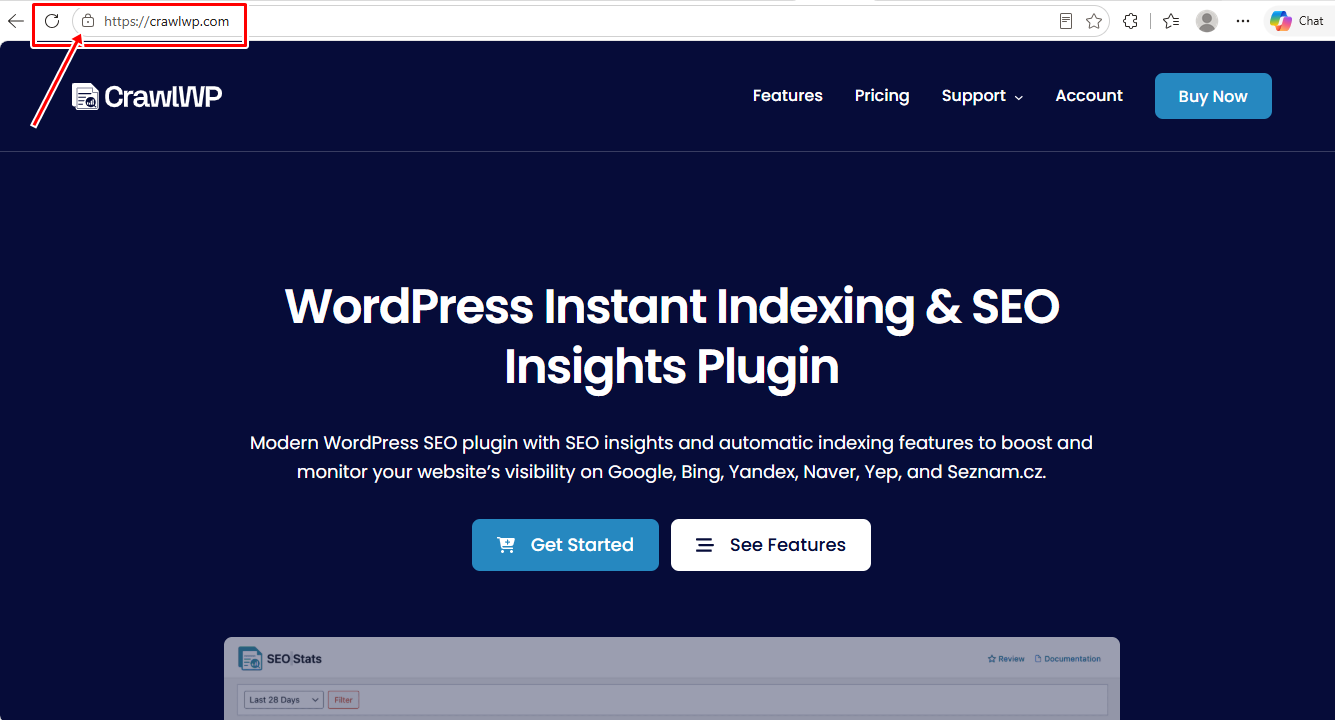
Most browsers actively flag non-secure websites as “Not Secure,” which can reduce clicks and increase bounce rates. Google also uses HTTPS as a lightweight ranking signal, meaning secure websites have a clear advantage in search results.
Technical accessibility focuses on how easily search engines can crawl, understand, and index your website. If your pages are blocked, slow, or returning errors, Google may struggle to process your content properly. This can lead to poor indexing or even missing pages in search results.
In simple terms, site security and technical accessibility ensure that your website is both trustworthy and reachable. Without these two elements working properly, even high-quality content can struggle to appear in search results.
Tips to Improve Site Security and Technical Accessibility
- Install and maintain a valid SSL certificate so your entire website runs on HTTPS.
- Keep WordPress core, plugins, and themes updated to reduce security risks
- Use reliable hosting with good uptime and fast server response times
- Regularly fix broken links and crawl errors to maintain efficient indexing
- Ensure your robots.txt file does not block important pages from search engines
- Submit and update your XML sitemap for better crawl efficiency
- Optimize site structure so important pages are easy to reach within a few clicks
- Use CrawlWP to speed up indexing and monitor SEO performance
- Run regular checks in Google Search Console to detect indexing or crawl issues early
- Test your website across mobile and desktop devices to ensure consistent performance
When your site is secure and technically accessible, you remove one of the biggest barriers to SEO success. It builds trust with users, improves crawl efficiency for search engines, and creates an excellent foundation for all other ranking factors to work effectively.
Ranking Factor #2: Search Intent and Content Relevance
Search intent and content relevance are very important ranking factors. If your content does not match what a user is actually looking for, it will struggle to rank, no matter how well optimized it is. Google’s goal is simple: to show the most useful result for every search. That means it is no longer enough to include the right keywords. You also need to understand the “why” behind the search.
Search intent refers to the reason someone types a query into Google. Are they trying to learn something? Are they comparing options? Are they ready to buy? Or are they looking for a specific website? Each of these intentions requires a different type of content.
For example, someone searching “best SEO plugins” expects a comparison or list, not a single product page. If your content does not match that expectation, users will leave quickly, and Google will notice.
Content relevance goes hand in hand with intent. Even if you understand the user’s goal, your content still needs to stay focused and directly answer their query. Pages that drift off-topic or try to cover too many unrelated ideas often perform poorly because they confuse both users and search engines.
Google has become extremely good at understanding meaning, context, and user satisfaction. It evaluates how well your page answers the search query, not just whether it contains the right keywords. This is why pages that clearly satisfy user intent often outrank longer or more “optimized” content that fails to stay relevant.
Tips to Improve Search Intent and Content Relevance
- Study the top-ranking pages for your target keyword to understand what Google is rewarding.
- Identify the intent behind each keyword before writing (informational, commercial, transactional, or navigational)
- Match your content format to intent (guides for learning, lists for comparisons, landing pages for buying)
- Answer the main question early in your content instead of delaying it
- Keep each page focused on one primary topic instead of mixing unrelated subjects
- Use headings that reflect real user questions and concerns
- Avoid keyword stuffing and focus on natural, helpful explanations
- Update your content if search results shift or user expectations change over time
By ensuring your content aligns closely with search intent and stays relevant throughout, you make everything else easier. Users stay longer, engage more, and trust your content. These signals tell Google that your page deserves to rank higher because it genuinely satisfies what people are looking for.
Ranking Factor #3: Content Quality and Topical Coverage
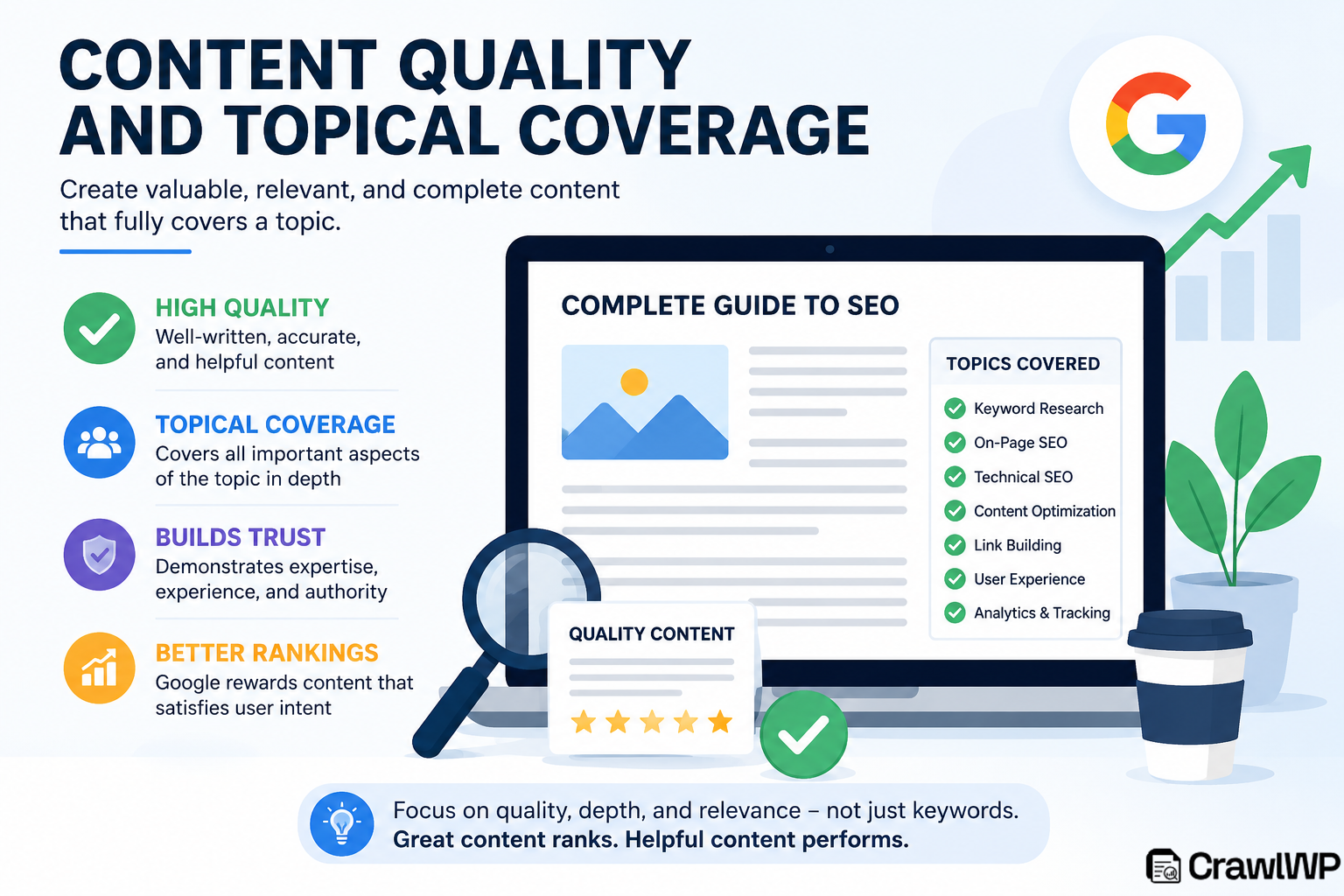
Content quality and topical coverage are two important signals that Google uses to evaluate websites. Once your site is secure and your content aligns with search intent, Google’s next focus is: does this page fully satisfy the searcher, and does this website demonstrate real depth in this subject?
If the answer feels weak or incomplete, rankings rarely hold for long.
Content quality is no longer judged by length or keyword usage alone. Google now evaluates how useful, clear, and satisfying your content is from a reader’s perspective. A high-quality page is one that answers the question clearly, explains concepts well, and helps the reader take action or understand a topic without needing to search elsewhere.
This means clarity matters just as much as depth. A well-written, focused article that directly solves a problem will outperform a longer piece that is vague or repetitive.
Another important part of content quality is originality. Google emphasizes content that adds something new to the web. This could be a unique explanation, practical experience, case studies, real examples, or even a clearer breakdown of a complex topic. Content that repeats what is already ranking tends to struggle because it does not offer users additional value.
Topical coverage takes this a step further. Instead of looking at a single page, Google evaluates how well your entire website covers a subject area. This is where many websites either grow or fall behind. A site that only publishes random, unrelated articles gives Google little confidence about its expertise. But a site that consistently publishes connected content around a clear niche begins to build what is known as topical authority.
For example, a website focused on SEO should not only write about ranking factors. It should also cover related areas, including keyword research, on-page SEO, technical optimization, backlinks, content strategy, and analytics. When these topics are connected through internal links and structured content, Google can clearly understand that your website has depth and experience in that niche.
Tips to Improve Content Quality and Topical Coverage
- Focus on solving the reader’s problem completely rather than writing to meet a word count.
- Use simple, clear explanations rather than overcomplicated language
- Add real-world examples, scenarios, or practical insights to make content more useful
- Build topic clusters by grouping related articles around a central theme
- Internally link related pages so users and search engines can easily navigate your content
- Avoid publishing isolated articles that do not connect to your main niche
- Regularly update existing content to improve accuracy and expand missing sections
- Analyze competitors to identify subtopics they cover that you may have missed
- Create content that answers follow-up questions users are likely to ask next
- Think in terms of full topic ownership, not just individual keyword rankings
- Review your site structure to ensure every important topic has supporting articles
Once your website has quality content and topical coverage, it becomes much easier for Google to trust it. Instead of seeing isolated pages, Google sees a structured knowledge base that consistently delivers value.
Over time, this leads to higher rankings, better visibility across multiple keywords, and more stable organic traffic.
Ranking Factor #4: Trust Signals (E-E-A-T and Brand Authority)
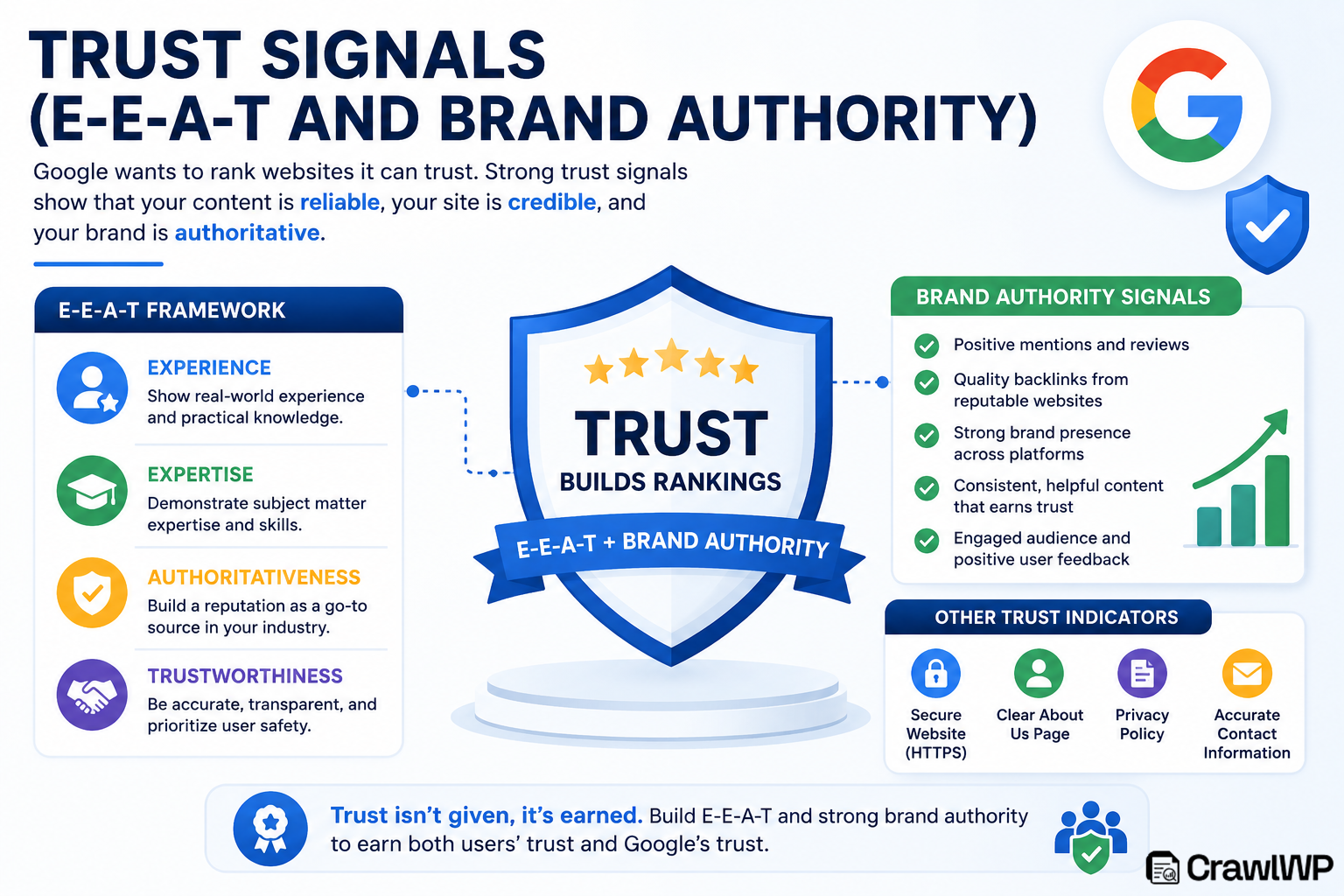
Trust signals are important SEO ranking factors because Google is no longer only trying to understand what your content says; it is also trying to decide whether your content can be trusted. A page can be well-written and optimized, but if it does not feel credible, it will struggle to compete with websites that users already rely on.
This is where E-E-A-T comes in. It stands for Experience, Expertise, Authoritativeness, and Trustworthiness, and it helps Google evaluate the quality of the source behind the content.
Experience means the writer has actually done or used what they are talking about. Expertise means the person understands the topic well. Authoritativeness is about how recognized the website or author is in that space. Trustworthiness focuses on accuracy, safety, and transparency. Together, these signals help Google judge whether a page deserves to be shown to users.
For example, if someone writes a review about a plugin after actually using it, that carries more weight than a generic article that repeats information from other websites. In the same way, a website that consistently publishes accurate, helpful content builds a good reputation over time, whereas one that publishes random or low-quality articles does not.
Brand authority also plays a big role in trust. This refers to how familiar and reliable your website or business appears across the internet. When people recognize your brand, search for it directly, mention it in discussions, or naturally link to it, Google sees that as a signal of trust. In simple terms, if users already trust you, Google is more likely to trust you as well.
Another important part of trust signals is transparency. Websites that clearly show who is behind the content tend to perform better. This includes having real author names, clear page numbers, and visible contact information. It helps users feel more confident that the content is coming from a real and accountable source.
Consistency also builds trust. A website that regularly publishes accurate, helpful, and well-structured content builds a great reputation over time. On the other hand, sites that publish misleading or inconsistent information often find it harder to maintain rankings, even if they later improve.
Tips to Improve Trust Signals and Brand Authority
- Add real author names to your content instead of anonymous posts
- Include short author bios that highlight experience or knowledge in the topic
- Write content based on real experience, testing, or research where possible
- Keep information accurate and avoid making claims you cannot support
- Build an effective “About” page that explains who you are and what your site represents
- Make your contact details easy to find to improve transparency
- Focus on earning genuine mentions and backlinks from trusted websites in your niche
- Encourage reviews or feedback if you run a business or product-based site
- Update old content regularly to keep it accurate and reliable
- Maintain a consistent tone and quality across all pages on your site
Note that trust signals do not grow overnight. They build gradually as users and search engines see your website consistently delivering reliable value. Once trust is established, it becomes much easier for your content to rank, even in competitive search results.
Ranking Factor #5: External Signals (Backlinks and Mentions)
External signals remain one of the ways Google understands how the rest of the internet views your website.
If other websites are talking about you, linking to your content, or mentioning your brand, it signals that your content has value. This is still very relevant, but the focus has shifted heavily from quantity to quality and context.
Backlinks are links from other websites that point to your pages. Think of them as votes of confidence. When a trusted website links to your content, it is basically telling Google, “this page is worth reading.” However, not all backlinks carry the same weight.
A link from a respected industry website will have far more impact than dozens of links from low-quality or unrelated sites. Google has become much better at detecting unnatural or spammy link patterns, so random link building no longer works the way it used to.
Beyond backlinks, brand mentions also matter. Even when a website mentions your brand without linking to you, Google can still pick up on these signals. This helps search engines understand how often your site is being referenced across the web and whether your brand is becoming known within its niche. Over time, consistent mentions build credibility, even if they are not always direct links.
Another important part of external signals is relevance. Links from websites that are closely related to your topic carry more value than links from unrelated sources. For example, if you run an SEO blog, a backlink from a digital marketing website is far more meaningful than a link from an unrelated entertainment blog. Google uses this context to understand whether your authority is actually relevant to your niche.
Tips to Improve Backlinks and Brand Mentions
- Focus on earning links from high-quality and relevant websites in your niche.
- Create content that people naturally want to reference, such as guides, case studies, and data-driven articles.s
- Build relationships with bloggers, publishers, and industry websites for organic mentions.
- Avoid buying spammy or low-quality backlinks, as they can harm your ranking.s
- Use guest posting carefully on reputable websites to build authority naturally.
- Promote your content through social media and communities to increase visibility. ity
- Create shareable content like statistics, insights, or how-to resources
- Monitor brand mentions and reach out to convert unlinked mentions into backlinks
- Prioritize relevance over volume when building links
- Focus on long-term authority building instead of quick link schemes
When your website has strong external signals, they serve as real-world validation of your website’s value. They show Google that people outside your own site find your content worth referencing, discussing, and sharing.
Over time, this kind of recognition builds momentum. Your pages gain more visibility, your brand becomes more familiar in your niche, and search engines start treating your site as a dependable source.
Ranking Factor #6: Site Structure and Internal Linking
Site structure and internal linking shape how search engines interpret your website and how visitors move through your content. When pages are arranged in a logical order, Google can understand what your site is about, which pages carry more importance, and how different topics connect.
Site structure refers to the overall arrangement of pages on your website. A well-planned structure usually starts with broad category pages, then moves into more specific subtopics. This creates a clear path for both users and search engines to follow. When everything is placed randomly, Google may struggle to identify relationships between pages, reducing visibility for important content.
Internal linking is the method of connecting pages within your website through hyperlinks. These links act like pathways that guide both users and search engines from one piece of content to another. They help Google discover new pages, understand how topics relate, and distribute visibility across your site. Without internal links, some pages may remain hidden or receive very little attention from search engines.
A good internal linking pattern also helps define your most important content. When multiple pages link back to a central article on a topic, it signals that the central article is more important within that subject area. This is often how websites build topical strength over time, especially in competitive niches.
For example, if a website has several articles about SEO, linking them together under a main “SEO ranking factors” page creates a connected structure. This not only helps users explore related topics easily but also gives search engines a clearer picture of how deep your knowledge goes in that area.
Another important benefit of internal linking is improving crawl efficiency. Search engines use links to move through your website. If pages are well-connected, Google can reach and index them faster. If pages are isolated or buried too deeply, they may take longer to appear in search results or may not be discovered at all.
Internal links also improve user behavior. When visitors find related content naturally while reading, they tend to stay longer and explore more pages. This sends positive engagement signals that can support better rankings over time.
Tips to Improve Site Structure and Internal Linking
- Organize your website around clear topic groups so related pages stay connected.
- Build a logical flow from broad pages to detailed subpages
- Place important pages closer to the homepage to improve visibility
- Add internal links naturally within content where they fit the topic context
- Use descriptive anchor text that clearly reflects the destination page topic
- Connect older articles with newer ones to keep content interconnected
- Identify orphan pages and link them back into related content clusters
- Build topic clusters where a main page connects to supporting articles
- Link from high-traffic pages to pages that need more visibility
- Avoid excessive linking in a single section that may distract readers
- Review your internal links regularly to maintain relevance as content grows
A well-planned structure combined with thoughtful internal linking turns a website into an organized knowledge system rather than a scattered collection of pages. This makes it easier for search engines to understand the depth of your content and helps your pages gain better visibility for related search terms.
Ranking Factor #7: User Experience and Page Performance
User experience and page performance directly influence how Google evaluates websites. Search engines are no longer judging pages only by what is written on them. They also observe how real people interact with those pages.
If users enjoy the experience, stay longer, and move around the site comfortably, it sends a positive signal. If they struggle, leave quickly, or avoid engaging, it signals the opposite.
User experience covers every interaction a visitor has with your website. This includes layout, readability, navigation, clarity, and ease of completing a task. For example, imagine a visitor landing on a blog post that has very small text, crowded paragraphs, and unclear headings. Even if the content is useful, the experience feels tiring. Many users will leave and choose another result that is easier to read.
Page performance focuses on how fast your website loads and how stable it feels during use. A slow-loading page creates friction before the user even sees the content. For instance, if a page takes more than a few seconds to load, visitors may press the back button and click another result.
Google may notice this behavior and reduce the visibility of that page over time. Stability is also important. If elements on the page jump around while loading, such as images or buttons shifting positions, it creates frustration and reduces trust.
Mobile experience plays a huge role in this ranking factor. Many users browse on mobile devices, so your website must adapt properly to smaller screens. A page that looks fine on desktop but forces mobile users to zoom, scroll sideways, or struggle with buttons will not perform well.
Tips to Improve User Experience and Page Performance
- Compress images before uploading to reduce page load time without losing clarity.
- Use caching so returning visitors load pages faster
- Remove unnecessary plugins or scripts that slow down your website
- Choose a hosting provider with a stable response time and minimal downtime
- Break long paragraphs into shorter sections for easier reading
- Use clear headings so users can scan content quickly
- Place important information near the top of the page so users do not need to scroll too far
- Avoid pop-ups that cover the main content or delay access to information
- Ensure buttons and links are large enough for mobile users to tap easily
- Test your website on different devices to check layout and usability issues
- Use internal links to guide readers to related content naturally
- Monitor user behavior in analytics to identify pages where visitors leave early
A good user experience combined with fast, stable performance creates a website that feels easy and comfortable to use. When visitors consistently have a positive experience, they are more likely to stay longer and explore more pages. Over time, these behaviors help search engines recognize your site as a reliable result and show it more often in search rankings.
Ranking Factor #8: Technical SEO
Technical SEO covers the behind-the-scenes setup that helps search engines crawl, understand, and organize your website.
This ranking factor focuses on four main areas: structured data, sitemaps, site architecture, and backend SEO setup. Each of these elements works together to make your website easier for search engines to interpret and index.
Structured data helps search engines understand the meaning of your content rather than just reading the text. It provides extra context about what a page represents. For example, structured data can tell Google whether a page is an article, a product page, a recipe, or an FAQ. This extra clarity can improve how your content appears in search results and increase relevance for specific queries.
Sitemaps act like a roadmap of your website. They list your important pages so search engines can discover them more efficiently. Without a proper sitemap, some pages may take longer to appear in search results, especially on larger websites. A well-maintained sitemap helps ensure that new or updated content is picked up faster during crawling.
Site architecture refers to how your pages are organized and connected. A clear structure makes it easier for search engines to understand which pages are most important and how different topics relate to each other. For example, a well-structured site might group related content under main categories, with supporting articles linked underneath. This creates a logical flow that improves both indexing and user navigation.
Backend SEO setup includes several technical elements that support overall site performance. This includes proper use of canonical tags, correct redirect setup, clean URL structures, and ensuring that important pages are not accidentally blocked from crawling. It also involves reducing errors that can confuse search engines, such as duplicate pages or broken links.
Tips to Improve Technical SEO
- Keep your XML sitemap updated so search engines can find new and updated pages quickly.
- Submit your sitemap through Google Search Console for better tracking and indexing.g
- Use structured data to give search engines a clearer context about your content type.
- Organize your website into clear categories so related pages are easy to group and understand
- Fix broken links and avoid unnecessary redirect chains that slow down crawling.g
- Use canonical tags to avoid confusion between similar or duplicate pages
- Make sure important pages are not blocked by robots.txt directives or incorrect settings
- Keep URLs clean, readable, and consistent across your website
- Regularly check crawl reports to spot indexing or access issues early
- Review your site structure to ensure important content is not buried too deep
When technical SEO is properly handled, your website becomes easier for search engines to process and interpret. This improves the efficiency of your page indexing and helps your content reach the right audience in search results.
Common SEO Myths to Ignore
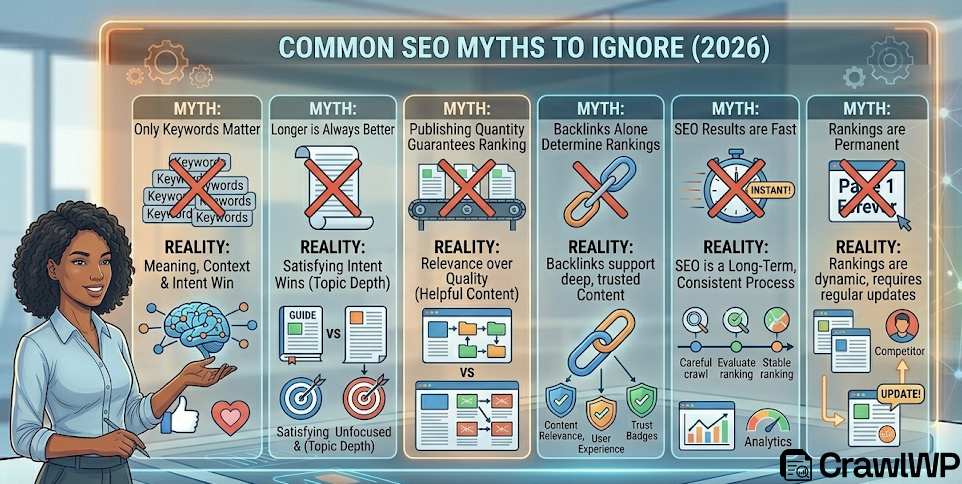
SEO advice changes often, and many outdated ideas still get repeated as if they were current. In 2026, relying on these misconceptions can slow down progress and lead to wasted effort.
Below are some common SEO myths to ignore;
1. SEO is only about keywords: One of the oldest misconceptions is that ranking depends mainly on keyword usage. While keywords are still important, they are no longer the main factor driving visibility.
Search engines now focus more on meaning, context, and user satisfaction. A page can rank without exact keyword repetition if it clearly answers the user’s query and matches intent. Overloading content with keywords can even reduce readability and hurt performance.
2. Longer content always ranks better: There is a belief that longer articles automatically perform better in search results. In reality, length alone has no direct impact on rankings.
What matters is whether the content fully answers the topic. Some queries need detailed explanations, while others require short, focused responses. A shorter page that satisfies user intent can outperform a longer article that includes unnecessary information.
3. Publishing more pages guarantees higher rankings: Some websites focus on publishing large volumes of content, assuming it will improve visibility. However, quantity does not replace relevance or quality.
Search engines evaluate how useful each page is. A smaller site with well-structured, helpful content can perform better than a large site filled with repetitive or low-value pages.
4. Backlinks alone determine rankings: Backlinks are important, but they do not work in isolation. A page with many links can still rank poorly if the content does not match search intent or lacks depth.
Modern ranking systems evaluate backlinks alongside other signals such as content relevance, user experience, and trust signals. This means links support visibility, but they cannot compensate for weak content.
5. SEO results happen quickly: SEO is often misunderstood as a fast process. In reality, it takes time for search engines to crawl, evaluate, and adjust rankings based on user behavior.
Some improvements may show early movement, but stable rankings usually develop over time. Consistency in content quality, technical setup, and user experience plays a much bigger role than short-term changes.
6. Once a page ranks, it will stay there permanently: Search rankings are not fixed. Competitors update their content, user behavior changes, and search systems evolve. Pages need regular updates and improvements to maintain their position over time.
Frequently Asked Questions About Google SEO Ranking Factors
Q1. What are SEO ranking factors?
SEO ranking factors are the signals Google and other search engines use to evaluate and rank web pages in search results. These signals help determine which page provides the best answer for a user’s query. They include content quality, search intent, website security, backlinks, page speed, internal linking, user experience, technical SEO, and many other elements.
Q2. What is the most important Google ranking factor in 2026?
Search intent alignment and helpful content are widely considered the most influential factors. If your content does not satisfy user intent, other ranking signals become less effective.
Q3. What is SEO ranking?
SEO ranking refers to the position your webpage occupies in search engine results for a particular keyword or phrase. For example, if your article appears as the first result when someone searches for “Google SEO ranking factors,” your page has achieved a high search ranking for that query. Better rankings often lead to more visibility, higher click-through rates, and increased organic traffic.
Q4: How can I improve my SEO ranking?
Improving your SEO ranking starts with understanding what your audience is searching for and creating content that answers their questions better than competing pages. You should also maintain a secure website, improve loading speed, organize content with logical internal links, earn high-quality backlinks, and keep your pages up to date. Regular technical audits and content reviews can also help identify areas that need attention.
Q5: How long does it take to achieve SEO high ranking?
There is no fixed timeline for achieving a high SEO ranking because results depend on competition, website authority, content quality, and many other factors. Some pages may gain visibility within a few weeks, while competitive topics can take several months or longer. Consistently publishing useful content and improving your website over time usually delivers better long-term results than expecting overnight success.
You can speed up content discovery by using CrawlWP, which automatically notifies search engines when you publish or update content. While faster indexing does not guarantee higher rankings, it helps search engines find your pages sooner so they can begin appearing in search results more quickly.
Q6: Is keyword optimization still important for SEO factors?
Yes, but keyword optimization has changed significantly. Search engines now understand context and user intent rather than relying only on exact keyword matches. Instead of repeating the same phrase multiple times, focus on writing naturally and covering the topic thoroughly. Using related terms and answering common user questions helps search engines understand your content while creating a better experience for readers.
Conclusion
Google’s ranking system keeps changing, but the main goal remains the same: to show users the most helpful results. That’s why focusing on quick tricks rarely works. What works is building a website that’s useful, easy to use, and actually helps people find what they’re looking for.
The Google SEO ranking factors covered in this guide work together to improve your visibility in search results. From having a secure, well-structured website to publishing helpful content, building trust, earning quality links, and improving page speed, each part plays its role in your long-term growth.
You don’t have to fix everything at once. Start with the areas where your website is struggling, improve them step by step, and keep an eye on your progress.
If you use WordPress, CrawlWP can help by making it easier for search engines to discover your new and updated content faster, so your pages don’t get delayed in search results.
We hope this article helped you learn about the important Google ranking factors.