
Indexing is the process by which a search engine collects, parses, and stores data to facilitate fast and accurate information retrieval. If your pages aren’t indexed, they won’t appear in search engine results, significantly reducing your website’s visibility.
CrawlWP’s SEO Indexing page allows WordPress website owners to monitor the index status of their content across Google, Bing, and Yandex search so they can take action to ensure they are discoverable on the internet.
The SEO Indexing Page
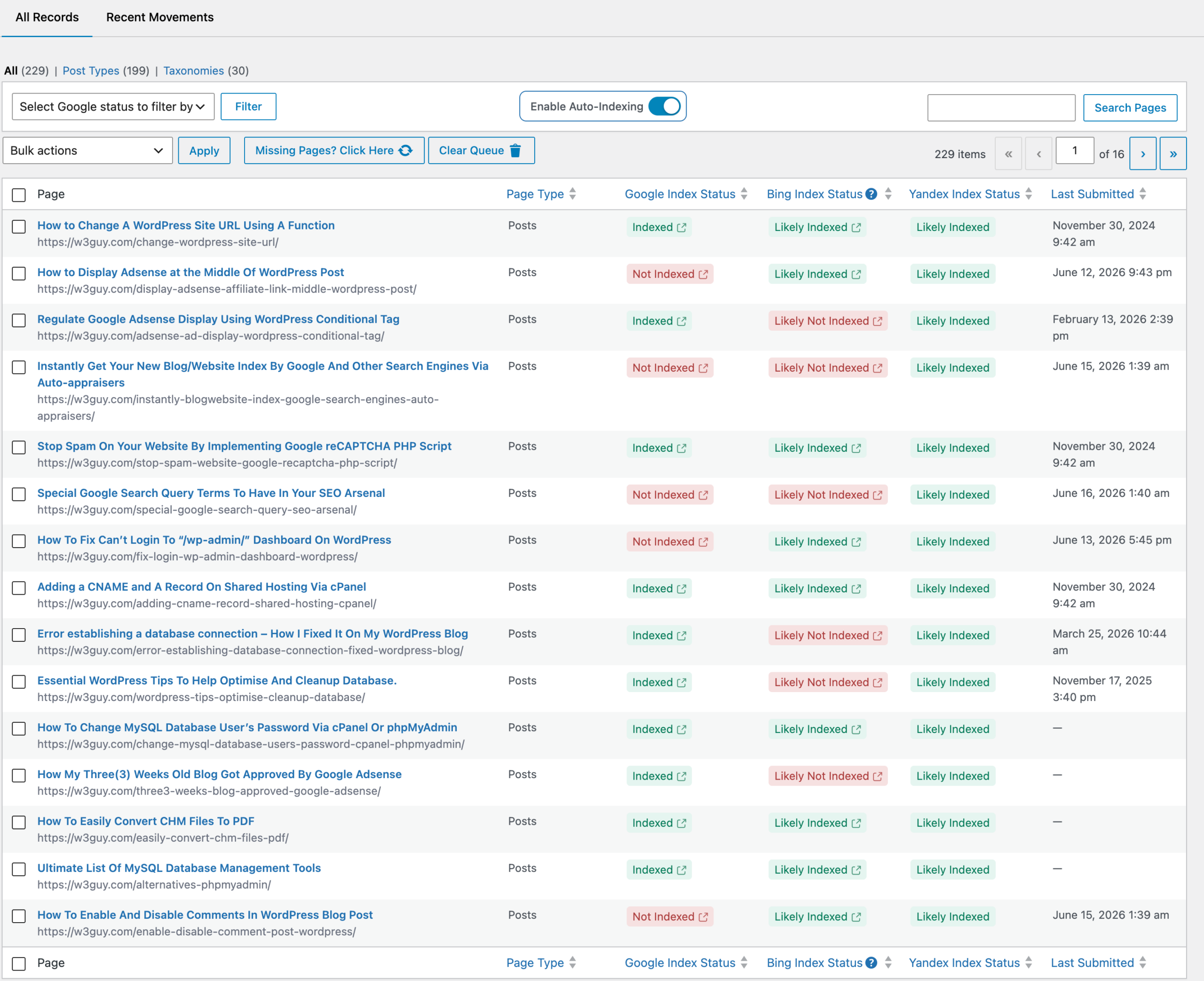
The CrawlWP SEO Indexing page provides a clear overview of your WordPress site’s index status in Google, Microsoft Bing, and Yandex, helping you stay informed at a glance.
Key Metrics
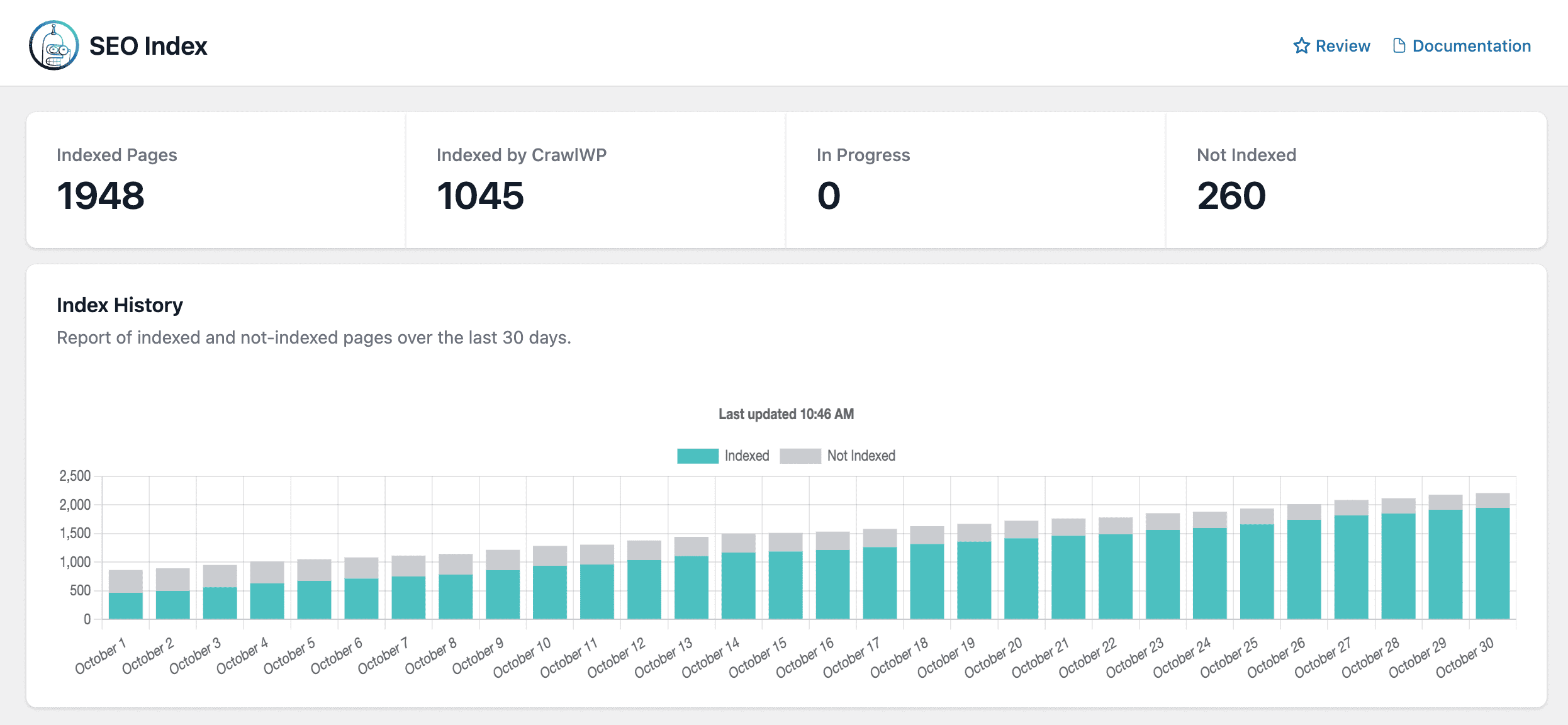
At the top of the dashboard, you’ll see four key metrics:
- Indexed Pages: Displays the total number of pages in WordPress successfully indexed by search engines.
- Indexed by CrawlWP: WordPress posts and pages that are currently indexed and became indexed after CrawlWP submitted them. Clicking the Indexed by CrawlWP filter above the table shows the same pages.
- In Progress: Pages currently being processed for indexing.
- Not Indexed: Pages that failed to be indexed or are yet to be checked.
These metrics provide an instant snapshot of your site’s overall indexing health.
Index History Graph
The graph below the metrics visualizes your WordPress site’s indexing activity over the past 30 days. It differentiates between pages that have been successfully indexed in Google and those that remain unindexed.
Managing Pages, Posts, and Taxonomies
Below the metrics and graph, CrawlWP lists all the pages, posts, and taxonomies on your WordPress website. This table includes:
- Page Name: The title of each page, post, or taxonomy.
- Page Type: Whether the content is a page, post, custom post type, or taxonomy.
- Google Index Status: Indicates if a page is indexed, in progress, or unchecked.
- Bing Index Status: Indicates whether a page is likely indexed by Bing. Clicking on the Bing Index Status label opens the Bing Webmaster Inspection page for the URL.
- Yandex Index Status: Indicates whether a page is likely indexed by Yandex.
- Last Submitted: The date the page was last submitted to search engines.
This table is fully interactive. You can search it for posts and categories, sort it by any status column, filter by specific content types, and take bulk actions to manage the indexing process.
For what each status means, see Understanding index statuses, including Likely Indexed.
One-Click Google & Bing URL Inspection Preview
You can click the index status to go directly to the URL Inspection page for the WordPress content in Google Search Console, where you can manually request indexing safely.

Similarly, clicking the index label in the Bing Index Status column opens the WordPress post/page URL in the Bing Webmaster Tools URL Inspection feature.

Using Auto-Indexing for Efficiency
CrawlWP includes an Enable Auto-Indexing feature that automates the submission of your pages and posts to search engines. When enabled, CrawlWP finds the posts and pages Google reports as not indexed and automatically submits them to the search engines you have enabled (e.g., Google, Bing, Yandex, and Yep through IndexNow).
This saves time and ensures your site remains up-to-date on search engine result pages (SERP). See How automatic indexing works for the full schedule.
Using the “Missing Pages? Click Here” Button
When you first install CrawlWP, your site’s pages and posts may not yet be loaded into the indexing table. This is where the “Missing Pages? Click Here” button is handy.
Located above the list of pages in the SEO Indexing dashboard, this button lets you quickly populate the table with your website’s content. After that, CrawlWP keeps the table up to date as you publish, unpublish, or delete content.
Recent Movements Information
On the SEO Indexing page, you’ll find a Recent Movements tab that tracks recently indexed and de-indexed posts, pages, custom post types, and taxonomies, along with the exact time of each change.

This gives you real-time visibility into how Google discovers and drops your content without digging through Search Console. You can quickly spot if important pages in WordPress fall out of the index and take action before it impacts your traffic. It also helps you confirm that new or updated content is being picked up by Google as expected.
Manually Checking Pages Index Status
To manually, forcefully check the index status of any page of your WordPress website, go to the SEO Indexing page, Click the checkboxes beside the pages whose index statuses you want to check, open the Bulk Actions select field and choose “Check Google Index Status” for Google, “Check Yandex Index Status” for Yandex and “Check Bing Index Status” if you want to know if the pages are likely indexed by Bing.
Manual Google checks count towards the 2,000 checks per day that Google allows for your site. See Google Indexing API daily quotas.

Submitting Pages for Indexing
CrawlWP allows you to manually submit any page for indexing using the Bulk Actions dropdown. This ensures your content is promptly sent to search engines for indexing.
Steps to Submit Pages for Indexing:
- Click the checkboxes beside the pages or posts you want to submit for indexing.
- Open the Bulk Actions dropdown above the table.
- Select “Submit for Indexing” from the list.
- Click the Apply button to start the submission process.
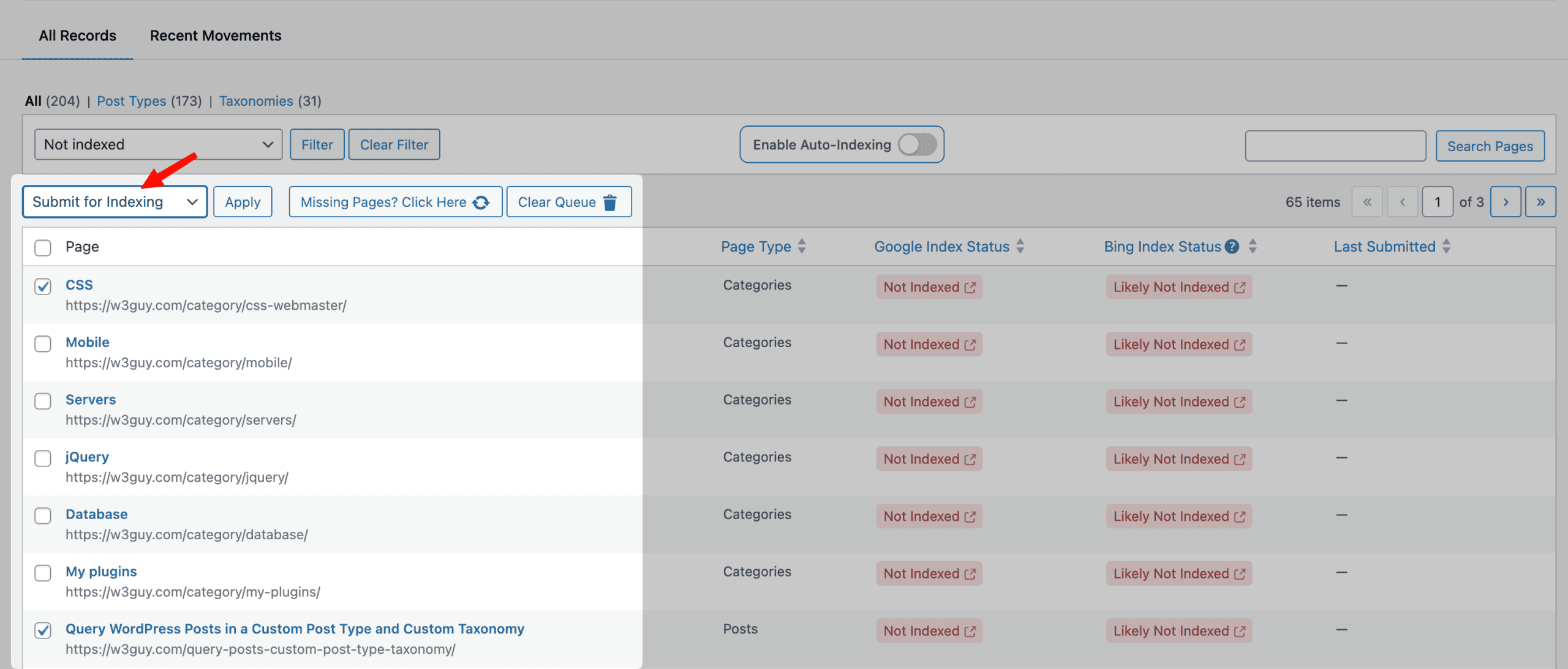
CrawlWP sends the selected pages to your enabled search engines in the background straight away, whether or not Enable Auto-Indexing is on. Each page is submitted once. Its status changes to In Progress for each search engine you have connected under API Settings, and stays there until CrawlWP next checks it.
Excluding and Including Pages
To keep pages out of CrawlWP’s indexing, select them, choose Exclude from indexing from Bulk Actions, and click Apply. Excluded pages are not submitted when you publish or update them, and auto-indexing skips them.
To undo it, select the pages and choose Include in indexing. Their status goes back to Not Checked, and CrawlWP checks them again on its normal schedule. See Excluding posts or post types from indexing.
Conclusion
CrawlWP’s SEO Indexing feature simplifies monitoring and managing your website’s visibility in search engines. Using its tools to submit pages, track indexing activity, and resolve issues helps ensure your content remains discoverable to your audience.
Take a proactive approach to SEO indexing today by utilizing CrawlWP’s powerful features to their fullest potential.