
CrawlWP can help your WordPress site notify Yep when content changes. Yep receives URL notifications through IndexNow, so you do not need a separate Yep integration or a Yep-specific setting in CrawlWP.
The key thing to understand is that CrawlWP does not submit directly to a Yep endpoint. Instead, it uses IndexNow, a shared system that lets participating search engines receive and share URL change notifications.
How Yep Receives Your URLs
Yep participates in IndexNow. When CrawlWP sends a URL through an IndexNow endpoint, the participating search engines can share that URL notification with one another. That means you do not need a Yep option in CrawlWP to notify Yep.
For example, CrawlWP can send the request to the shared IndexNow address, https://api.indexnow.org/indexnow. The notification can then reach participating engines, including Yep.
This also means the CrawlWP log does not show a separate Yep destination. The log records the IndexNow destination you selected, not every search engine that may receive the shared notification.
Configure the IndexNow Connection
- Go to CrawlWP > Settings and click the Indexing tab at the top.
- Click IndexNow in the left-hand menu.
- Make sure Enable is switched on.
- Under Search Engine, choose IndexNow when you want to use the shared IndexNow address,
https://api.indexnow.org/indexnow
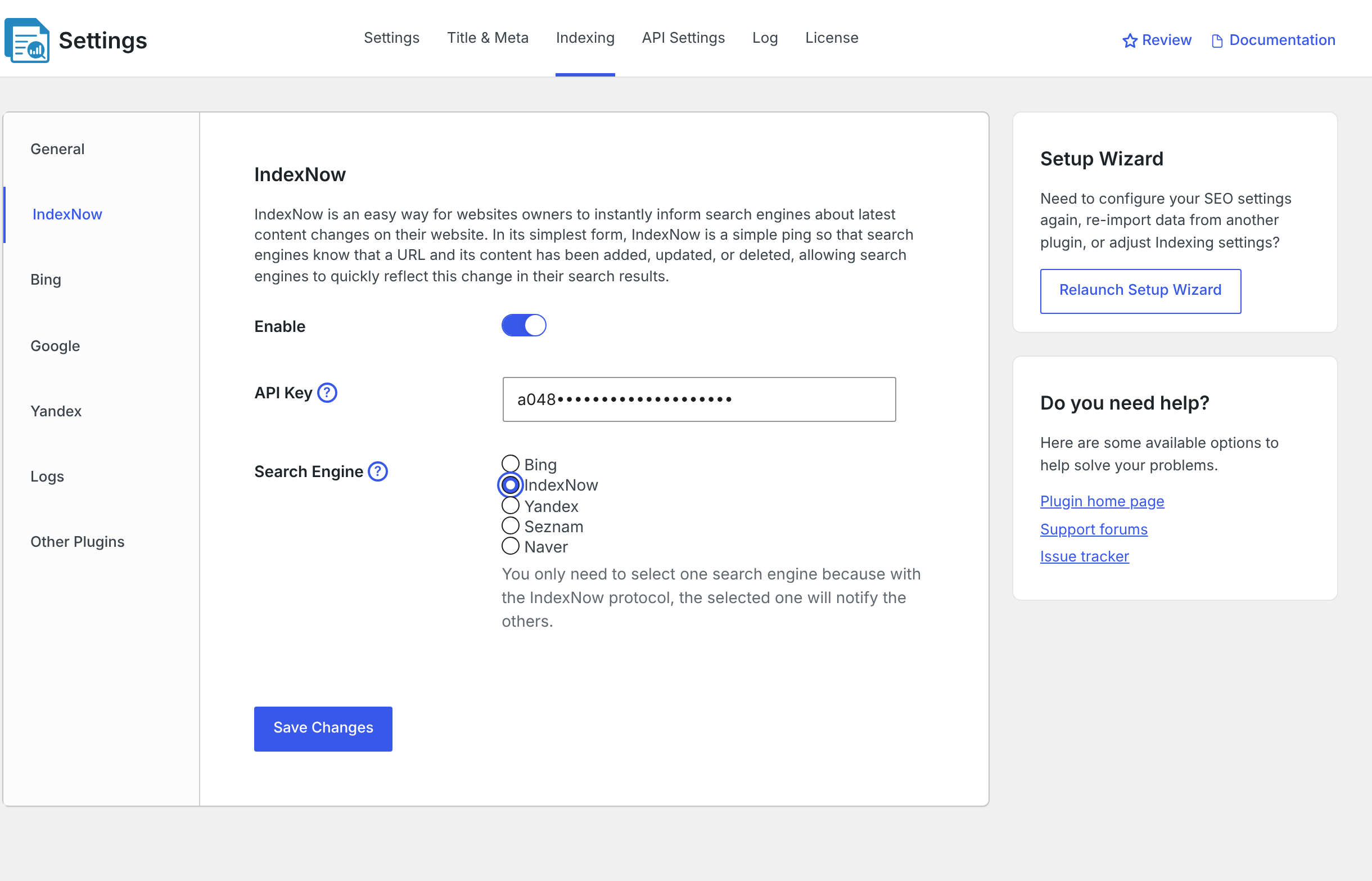
- Click Save Changes.
You do not have to select a search engine named Yep because there is no separate Yep option in CrawlWP. Using the shared IndexNow destination is enough for Yep to receive the notification through the IndexNow network.
Tell CrawlWP Which Changes to Send
The IndexNow destination is only part of the setup. CrawlWP also needs to know which WordPress content to submit to Yep for indexing and which changes should trigger a notification.
- Open the General section from the Indexing tab.
- Under Post Types and Taxonomies, select the content you want CrawlWP to submit.
- Under Notify Search Engines when, enable Post added if new content should be submitted.
- Enable Post updated when changes to existing published content should also trigger a submission.
- Click Save Changes.
For a new site, it is worth checking these settings before testing Yep. If the relevant post type is not selected, or the event you are testing is disabled, there may be nothing for CrawlWP to submit. See Excluding posts or post types from indexing for more information.
Test the Setup from WordPress
The simplest test is to submit a published page manually and then inspect the CrawlWP log. This avoids waiting for a new post or an automatic update event.
- Open a published post in the WordPress editor.
- In the CrawlWP SEO box, open the Advanced tab and click Submit for Indexing.
- Go to CrawlWP > Settings and click the Log tab.
- Find the new IndexNow entry and check the Status column.
A 200 response means the address was accepted. A 202 response means IndexNow accepted the address but has not finished checking the key yet. Neither response means that Yep has already indexed the page.
Because CrawlWP submits through IndexNow rather than directly to Yep, you should use the CrawlWP log to confirm that the request was accepted, then use Yep’s own tools or search results to investigate what happens afterward. See Reading the indexing submission log.
Why You Will Not See Yep in the CrawlWP Log
This can be confusing when you are testing the setup. CrawlWP records the IndexNow service you selected under Search Engine. It does not create a separate log row for every search engine that receives a shared IndexNow notification.
For example, if you select IndexNow, the log records the shared IndexNow request. It does not need to display a separate Yep entry for the setup to work.
Check the IndexNow Key if a Request Fails
If the log contains a 403 response, the search engine could not confirm your IndexNow key. A useful first check is the key file on your own site.
- Find the key shown in the API Key field in your CrawlWP settings.
- Open
https://your-site.com/{key}.txtin a browser, replacing{key}with the actual key. - Confirm that the page displays the same key.
If the URL returns a 404 page, go to Settings > Permalinks in WordPress and choose any option other than Plain.
When the Page Is Still Missing from Yep
A successful IndexNow submission only confirms that the notification was accepted. It does not force Yep to crawl the URL, index it, or show it in search results.
Before troubleshooting the search result itself, confirm that the CrawlWP log contains a successful IndexNow response. If the submission succeeded, the next step is outside CrawlWP: check whether Yep has crawled and indexed the page.
Common Yep Indexing Problems
- No submission appears: check Enable, the selected Search Engine, the relevant Post Types or Taxonomies, and the Post added or Post updated setting you are testing.
- The log shows 403: verify that the IndexNow key file is publicly accessible at the expected URL.
- The log shows 429: the search engine has received too many requests. Repeated submissions will not make indexing happen faster.
- The request succeeds, but Yep does not show the page: remember that IndexNow is a notification mechanism and does not guarantee indexation.
What to Remember About Yep and CrawlWP
You do not need a Yep-specific integration in CrawlWP. Configure IndexNow, select the shared IndexNow destination, make sure the content and submission events you need are enabled, and use the CrawlWP log to confirm that requests are being accepted.
Once CrawlWP successfully sends the notification, Yep decides what to do with the URL. A successful IndexNow request is therefore a successful notification, not a promise that the page will appear in Yep search results.
See what IndexNow is and which engines use it to learn more about how CrawlWP uses IndexNow and which search engines participate.