
Most comparisons of Ahrefs and Majestic start with the wrong premise.
They line up both tools feature by feature, declare a winner based on who has more columns checked, and send you off to make a decision based on a table that misrepresents what either product does.
At a general level, these two platforms provide similar support for an SEO professional in areas such as backlinks, overall link quality, and domain-level research.
However, they use different approaches to accomplish their objectives.
That is true and polite.
Here is the more useful version: Ahrefs and Majestic are not really competing with each other. Ahrefs is a broad SEO platform for multi-channel operators. Majestic is a specialized link intelligence tool for deep forensic analysis.
If you need keyword research, rank tracking, site audits, content analysis, and backlink data, you need Ahrefs. If backlink vetting, link quality scoring, and historical link forensics are your core workflows, Majestic does those things in ways Ahrefs does not match.
The real question is never “which tool is better?” It is “which tool fits the work you actually do?”
This comparison addresses that by examining pricing, backlink index differences, the specific metrics each tool uses, the features each has and lacks, and the scenarios where each genuinely wins.
Table of Contents
Quick Verdict (For People Who Want It First)
Choose Ahrefs if: You need an all-in-one SEO platform covering keyword research, rank tracking, site audits, content analysis, and backlinks. You manage multiple clients or sites and need everything in one place. You want the freshest backlink data for monitoring active campaigns.
Choose Majestic if: Backlink analysis and link vetting are your primary job function. You need historical link data going back years for penalty recovery or expired domain research. You want Trust Flow and Topical Trust Flow as your link quality benchmarks. You want professional-grade link intelligence at a lower entry price than Ahrefs.
Use both if: Your agency runs active link-building campaigns and needs both fresh monitoring data (Ahrefs) and deep forensic link vetting (Majestic). Many professionals use both tools simultaneously: Ahrefs for competitive research, keyword strategy, and content intelligence, and Majestic for deep link auditing, Trust Flow analysis, and bulk link evaluation.
Now let’s get into the specifics.
Pricing: What You Pay In 2026
Ahrefs Pricing
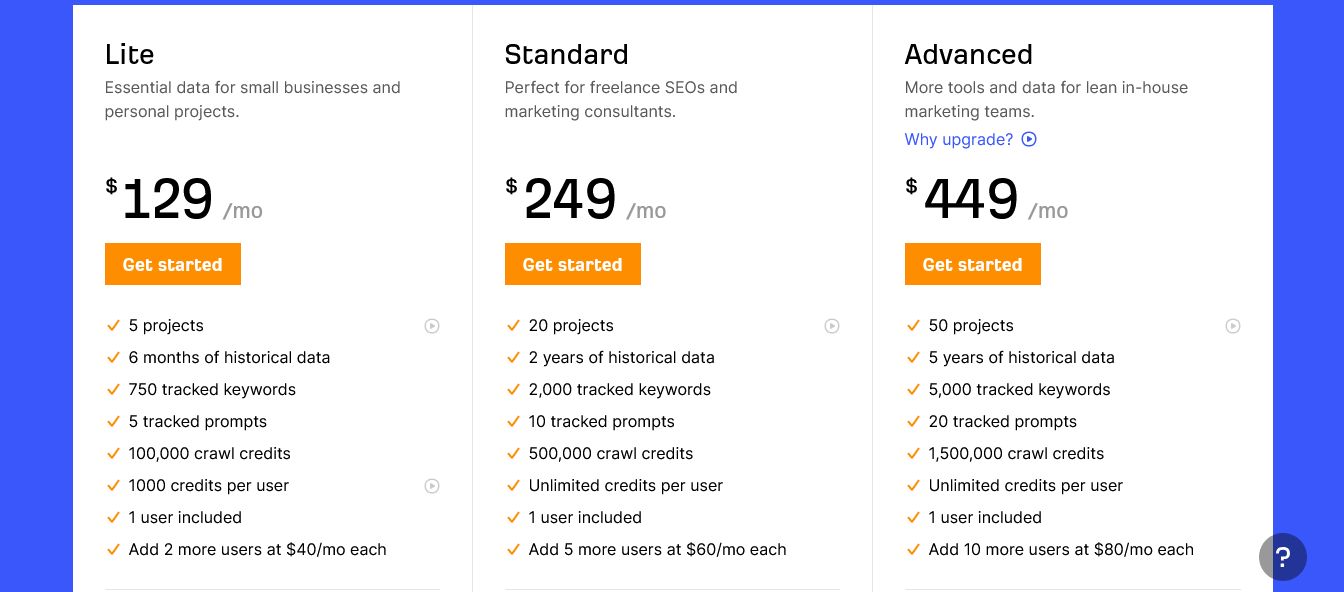
Ahrefs has five plans:
- Starter: $29/month (monthly billing only, 1 project, limited credits, no annual option)
- Lite: $129/month monthly / $108/month annually (5 projects, 750 tracked keywords)
- Standard: $249/month monthly / $208/month annually (20 projects, 2,000 keywords, Content Explorer)
- Advanced: $449/month monthly / $374/month annually (50 projects, 5,000 keywords)
- Enterprise: $1,499/month (annual billing only, custom limits, SSO, API access)
Annual billing saves approximately 17%, which Ahrefs markets as two months free.
Ahrefs Webmaster Tools is free for verified site owners and covers backlink checking and site audits for your own properties. There is no free trial on any paid plan.
The Starter plan at $29/month is the lowest-risk way to test data quality before committing.
The real Ahrefs cost most reviews miss:
Every plan below Enterprise includes exactly one user. Extra full seats cost $40/month on Lite, $60 on Standard, and $80 on Advanced.
Add-ons are not included in any plan: Brand Radar (AI visibility tracking) starts at $199/month. Content Kit starts at $99/month. Project Boost (faster crawling for specific sites) costs $20/month per project.
A two-person Standard agency running Content Kit, Report Builder, and Project Boost across five projects comes to roughly $607/month, about 2.4 times the headline plan price.
Which Ahrefs plan do you really need?
Ahrefs Standard at $249/month is the right plan for most agencies. It adds Content Explorer, Portfolios, and 2,000 tracked keywords. Lite at $129/month is only right if backlink monitoring is your sole use case.
The Starter plan at $29/month is too limited for professional use. Most features people actually use only become accessible from Standard upward.
Majestic Pricing
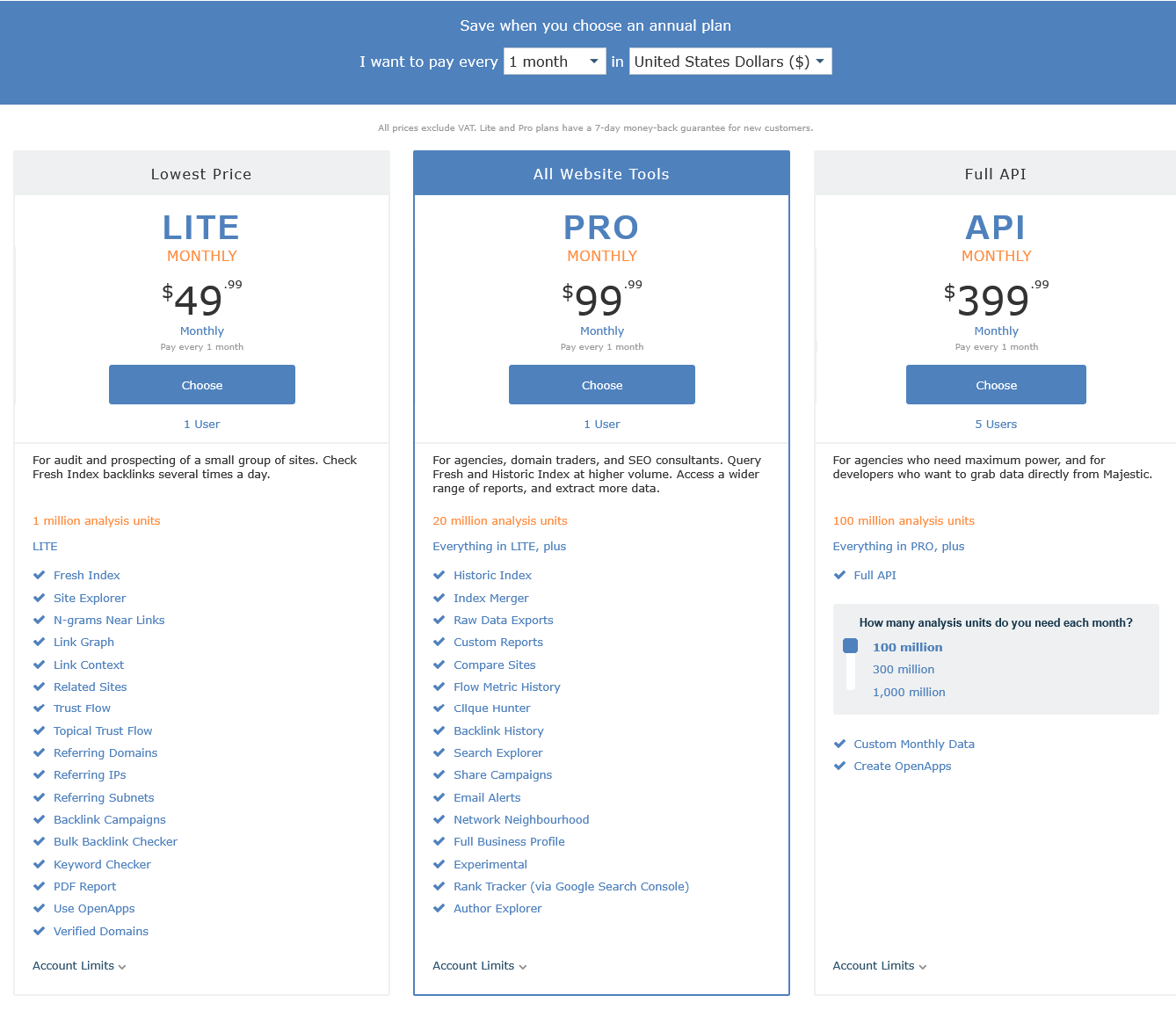
Majestic has three plans:
- Lite: $49.99/month monthly / $41.67/month annually ($499.99/year)
- Pro: $99.99/month monthly / $83.33/month annually ($999.99/year)
- API: $399.99/month monthly / $333.33/month annually ($3,999.90/year)
A 7-day money-back guarantee applies to new customers on Lite and Pro.
Lite at $49.99/month includes Fresh Index access, Site Explorer (limited), and 5 million Analysis Units.
Pro at $99.99/month adds Historic Index, full Site Explorer, Clique Hunter, Bulk Backlink Checker, and 20 million Analysis Units.
The critical Lite vs Pro distinction:
Lite is Fresh Index only. If you need long-term link history, Pro is the entry point, not Lite.
For penalty recovery work, expired domain research, or any analysis that requires a domain’s full historical link record, the Lite plan simply lacks the data.
Pricing comparison:
Majestic Pro, at $99.99/month, offers specialized backlink intelligence far better than any Ahrefs plan at a comparable price. But Majestic Pro does not include keyword research, rank tracking, or technical auditing.
If you need all those features, Ahrefs Standard at $249/month is roughly $45 per major feature category, which is cheaper than buying Majestic Pro plus a separate keyword tool, rank tracker, and audit platform.
The math matters:
If backlinks are your only need, Majestic Lite at $49.99/month is dramatically more affordable than Ahrefs Lite at $129/month. If you need a full SEO stack, Ahrefs becomes cost-efficient because you are not paying for four separate tools.
Backlink Index: Size, Freshness, and History
This is where the real difference lives.
Ahrefs Backlink Index
Ahrefs crawls over 8 billion pages daily for comprehensive SEO tasks.
The index prioritizes freshness: new links and lost links appear quickly, which matters for monitoring active outreach campaigns, spotting competitor link acquisitions in near real-time, and identifying when a recently earned link drops.
Ahrefs’ fresher index is better for monitoring active campaigns.
If you ran a digital PR campaign last week and want to see which links were picked up, Ahrefs surfaces them faster than Majestic’s Fresh Index.
The index covers the full breadth of what Ahrefs does: organic traffic estimates, keyword rankings, and content performance alongside backlink data. This breadth is what makes Ahrefs useful as a single-platform solution.
Majestic Backlink Index
Majestic operates two distinct indexes:
Fresh Index: A rolling 90-day backlink index, refreshed continuously. Useful for catching new and recent links.
Historic Index: The long-term link database going back many years. Useful for tracking a domain’s full link history, finding lost links, and comprehensive archive analysis. The Historic Index is exclusively available to Pro plan subscribers.
Majestic’s deep Historic Index is irreplaceable for penalty recovery and due diligence, allowing you to see a domain’s link profile from years ago.
When a site has been penalized, and you need to understand what links caused the problem, or when you are evaluating an expired domain and need to verify it was never part of a spam network, the Historic Index gives you data that no other tool provides at this level of depth.
Detection Speed (Tested)
Based on identical domain testing over six weeks, Ahrefs detected new links significantly faster than Majestic in most cases.
For actively monitoring link acquisition campaigns, Ahrefs is the more responsive tool. For understanding a domain’s complete historical link story, Majestic’s Historic Index has no equivalent.
Backlink Metrics: Domain Rating vs Trust Flow

This is the most important conceptual difference between the two tools.
Ahrefs Domain Rating (DR)
Domain Rating is an Ahrefs metric focused on the quantity and quality of referring domains. It is a logarithmic scale from 0 to 100. The higher the score, the stronger the backlink profile.
DR measures the strength of a site’s link profile relative to other sites in Ahrefs’ index. A DR 60 site has a significantly stronger link profile than a DR 50 site, with the difference increasing exponentially at higher scores due to the logarithmic scale.
The DR limitation worth knowing:
A high DR can be misleading. A site with DR 45 might have earned that authority through genuine editorial links. Another site with a DR of 45 might have inflated its score through expired domain redirects and PBN links.
DR measures link volume and authority signals, but it does not deeply evaluate the quality or trustworthiness of the links contributing to that score.
Majestic Trust Flow and Citation Flow
Majestic uses two companion metrics:
Trust Flow (TF): A score between 0 and 100 that models the quality of links pointing to a URL or domain. Trust Flow measures how closely a website’s backlinks align with a set of manually curated trusted seed sites, indicating the overall trustworthiness of a site’s link profile.
Citation Flow (CF): A score that reflects the quantity of links that point to any given website. Citation Flow does not evaluate whether a link is of good or poor quality.
TF/CF ratio: the most useful signal Majestic offers
More important than the absolute score is the TF: CF ratio.
A TF of 25 with CF of 28 (ratio 0.89) is far more valuable than a TF of 30 with CF of 90 (ratio 0.33).
A TF: CF ratio above 0.5 signals a healthy, trust-weighted link profile. Below 0.3 suggests spam risk.
In practical terms, a site with high CF and low TF has many links, but most are low-quality or spammy. That is a reliable spam signal that DR alone would not surface.
Example: A site shows a DR of 45 in Ahrefs, which looks like a decent link prospect. But in Majestic, it shows a Trust Flow of 12 and a Citation Flow of 45. The high CF confirms it has many links, but the low TF shows those links come from low-quality neighborhoods. DR would not surface this problem. The TF/CF ratio does.
Topical Trust Flow: Majestic’s Most Specialized Feature
Topical Trust Flow is a Majestic-trademarked metric that categorizes websites by topic to understand topical relevancy. It shows which industry sector a website influences, on a logarithmic scale from 0 to 100.
This matters for link vetting because a link from a topically relevant site carries more SEO value than a link from an unrelated site.
If you run a cooking blog but your highest Topical Trust Flow category is gambling, that is a sign of an unnatural link profile.
Identifying this kind of topical mismatch is precisely what Topical Trust Flow is built to surface.
Ahrefs does not have an equivalent to Topical Trust Flow.
Feature Comparison: What Each Tool Includes
What Ahrefs Has That Majestic Does Not
Keyword Research: Ahrefs’ Keywords Explorer covers billions of keywords across multiple search engines with search volume, keyword difficulty, click data, and SERP analysis. Majestic has a basic keyword generator but nothing approaching this depth.
Rank Tracking: Ahrefs tracks daily keyword positions across Google and other search engines. Majestic offers no rank tracking.
Site Audit: Ahrefs’ site crawler identifies technical SEO issues across your entire domain, including broken links, redirect chains, missing meta tags, slow pages, and Core Web Vitals issues. Majestic has no site-crawler or technical-audit capabilities.
Organic Traffic Estimates: Ahrefs estimates how much organic traffic any website receives from search, and which pages drive that traffic. Majestic provides no organic traffic data.
Content Explorer: Ahrefs’ Content Explorer (available from Standard plan) identifies high-performing content by topic, useful for finding link prospects and content gap opportunities. Not available in Majestic.
Competitive Research: Ahrefs provides full competitor keyword gap analysis, organic traffic comparisons, and top content breakdowns. Majestic offers limited competitive comparison.
What Majestic Has That Ahrefs Does Not Match
Historic Index: Years of link history that Ahrefs’ fresher index does not preserve. Critical for penalty recovery, expired domain research, and full domain due diligence.
Trust Flow and Citation Flow: The TF/CF ratio as a spam detection signal has no direct Ahrefs equivalent. DR does not surface the same quality-vs-quantity relationship.
Topical Trust Flow: Topic-categorized link authority across 800-plus topical categories. Nothing in Ahrefs maps link profiles to topical relevance in this way.
Clique Hunter (Pro plan): Clique Hunter identifies sites that link to multiple competitors but not to you, which is one of the best workflows for finding link-building opportunities. Ahrefs has link intersection features, but Clique Hunter’s multi-competitor link overlap analysis is a distinct workflow.
Neighborhood Checker: The Neighborhood Checker identifies whether a site shares IP blocks with known spam or PBN networks. This level of forensic link environment analysis is unique to Majestic.
Link Context: Link Context shows the surrounding text of every backlink, helping SEOs evaluate link relevance and context beyond just anchor text.
Use Case Scenarios: Which Tool Wins Where
Scenario 1: Content Marketing and SEO Strategy
You manage SEO for a SaaS company. You need to identify keyword opportunities, track rankings, audit for technical issues, and analyze competitors.
Winner: Ahrefs, clearly. Majestic has no keyword research, no rank tracking, and no technical audit. Ahrefs covers all of it.
Scenario 2: Link Prospecting for Outreach
You are building links for a client site. You need to vet 200 prospect domains for link quality before your team invests time in outreach.
Winner: Majestic, by a significant margin. The TF/CF ratio and Topical Trust Flow filter out low-quality prospects faster and more reliably than DR alone. This is the specialist workflow where Majestic’s metrics are the daily tools of the trade.
Scenario 3: Penalty Recovery and Link Audit
A client’s site received a manual action from Google. You need to build a disavow file by identifying and evaluating every toxic link pointing to the domain, including links that may be years old.
Winner: Majestic, definitively. The Historic Index is the only tool that provides long-term link data at this depth. Ahrefs’ fresher index may miss older toxic links that stopped pointing to the site years ago.
Scenario 4: Expired Domain Research
You are evaluating 50 expired domains for potential acquisition or redirect use. You need to verify their link history is clean before purchasing.
Winner: Majestic. The Historic Index lets you see a domain’s full link story going back years, not just the last 90 days. Ahrefs’ fresher index is better for monitoring active campaigns. Majestic’s deep Historic Index is irreplaceable for due diligence.
Scenario 5: Agency Managing Multiple Clients
You manage SEO for 15 clients with a mix of technical issues, content gaps, ranking declines, and link building needs.
Winner: Ahrefs, for the breadth of the stack. Covering keyword research, rank tracking, audits, and backlinks in one platform at a manageable per-seat cost makes Ahrefs the practical choice for diverse client work.
Scenario 6: Pure Link Building Focus
Your job is to find, vet, and acquire links. That is the entire scope of your work.
Winner: Majestic for quality vetting, Ahrefs for prospecting volume. Many dedicated link-building teams use both Ahrefs to find prospects and Majestic to qualify them before outreach begins.
Accuracy Question: Which Index Is More Reliable?

Ahrefs and Majestic diverged more often than expected across six weeks of identical domain testing.
That divergence is the most useful signal this comparison can offer.
The divergence is not a sign that one tool is wrong. The two indexes are genuinely different. Ahrefs prioritizes freshness and breadth. Majestic prioritizes depth and historical completeness.
A link that Ahrefs no longer shows (because it expired) may still appear in Majestic’s Historic Index. A link acquired last week may appear in Ahrefs before Majestic detects it.
Raw index size, quoted as “14 trillion live backlinks” or “20 trillion unique URLs,” is a vanity metric. The operationally critical factor is the index architecture: how often the data is refreshed and how far back it goes.
For active campaign monitoring, Ahrefs’ fresher data is the better tool. For deep historical analysis, Majestic’s archive is irreplaceable.
Interface and Usability
Ahrefs
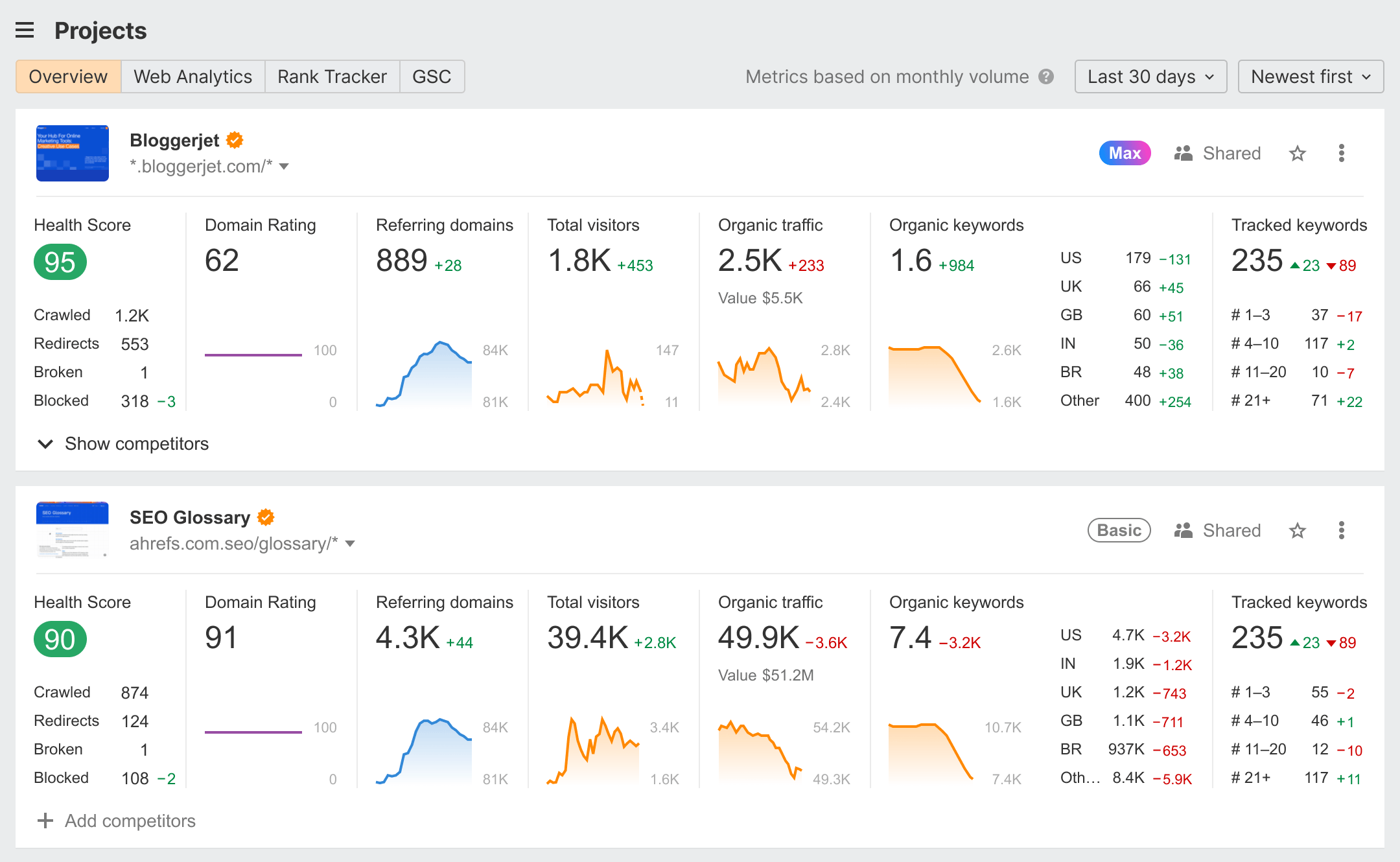
Ahrefs has a more intuitive interface and comprehensive tutorials, making it much easier for beginners.
The dashboard is modern, well-organized, and accompanied by extensive documentation. New users can quickly navigate to meaningful data, and the learning curve is manageable for most SEO practitioners.
The sheer number of tools (Site Explorer, Keywords Explorer, Site Audit, Rank Tracker, Content Explorer, Web Explorer) makes the interface highly complex.
Navigating between tools for different research tasks takes time to become fluid.
Majestic
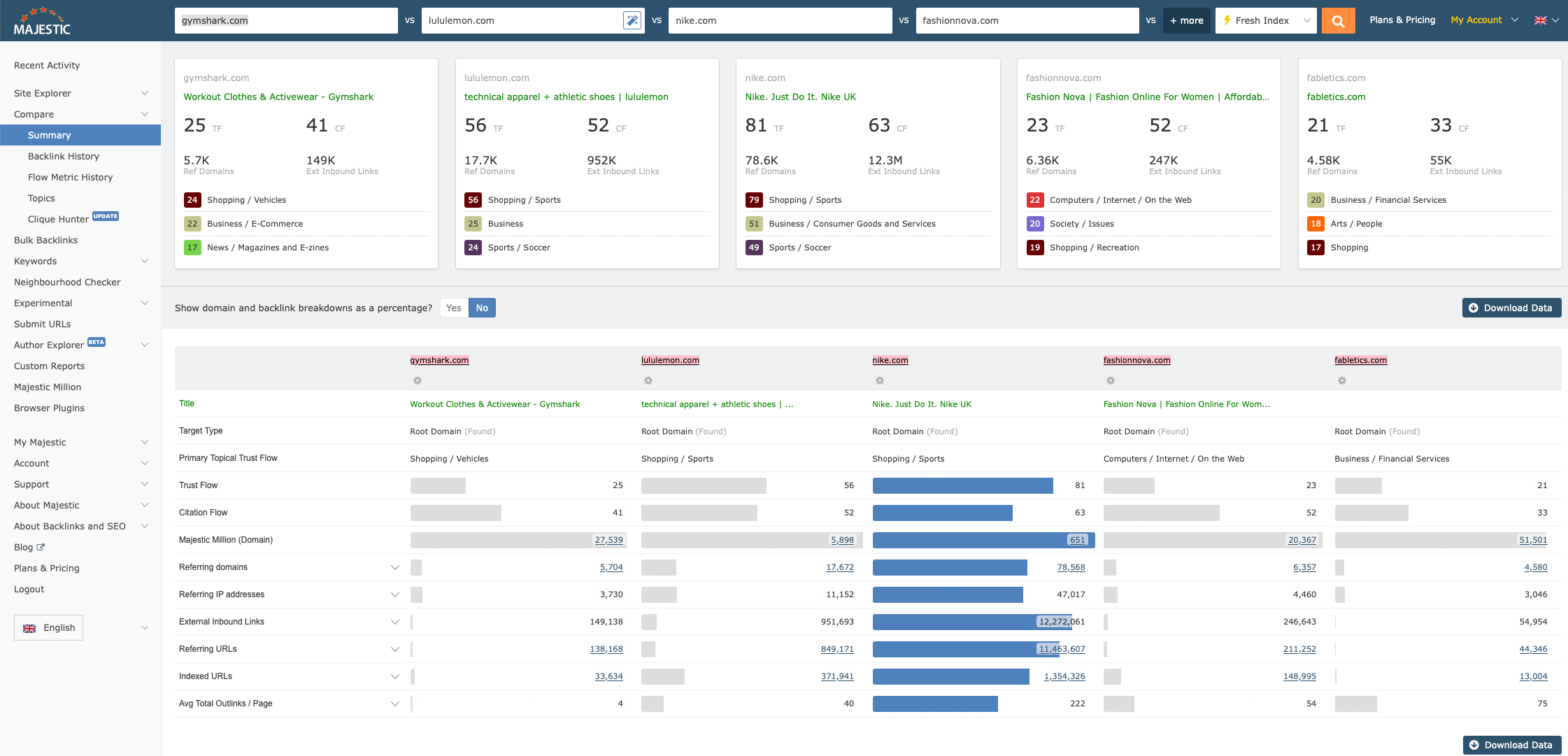
Majestic’s interface is more utilitarian.
The interface feels dated compared to modern tools. Navigation is functional rather than polished.
For specialists who use Majestic daily for a narrow set of tasks, the interface becomes familiar quickly. For occasional users who pick it up for specific projects, it can feel less intuitive than Ahrefs.
The depth of data Majestic surfaces in its reports compensates for the interface limitations for users who need what it provides.
Free Options: What You Can Access Without Paying
Ahrefs Free Options
Ahrefs Webmaster Tools is free for verified site owners and covers backlink checking and site audits for your own properties.
This is genuinely useful for monitoring your own backlink profile and running technical audits without a paid subscription.
Ahrefs does not offer a free trial on paid plans. The $29/month Starter plan is the lowest-cost option for checking competitor data.
Majestic Free Options
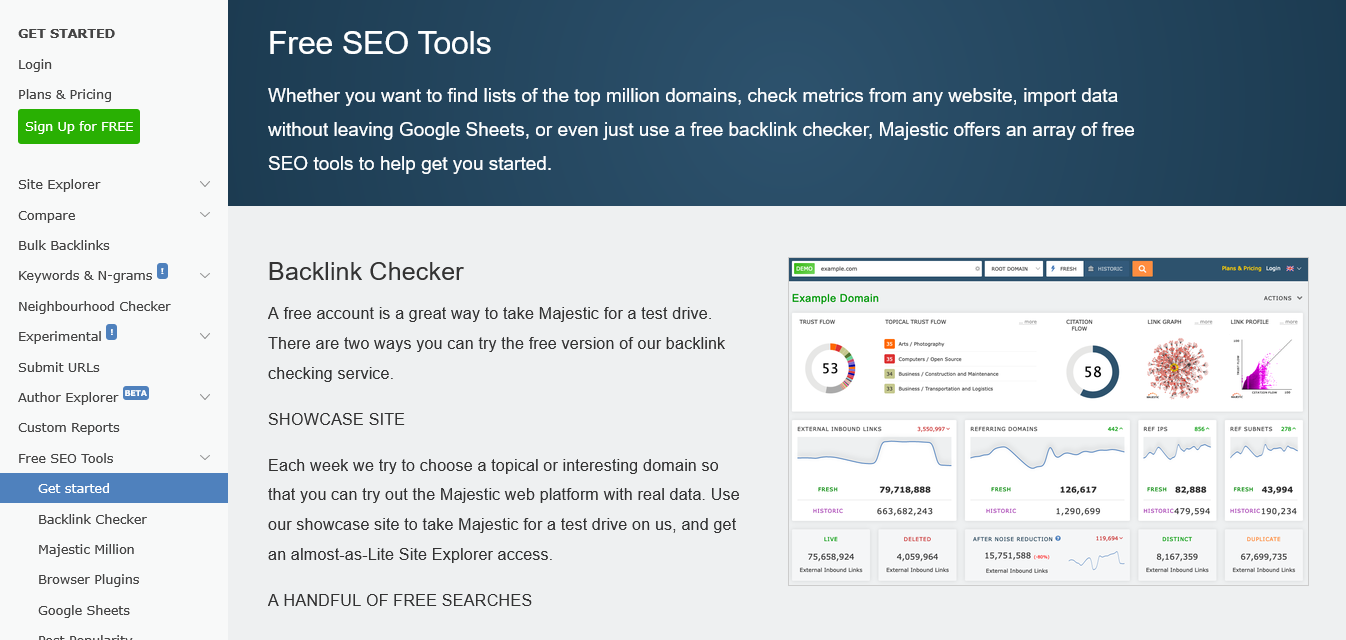
Majestic offers a free account with limited access to Site Explorer, including a handful of free searches per day. If you verify your own website, you can access additional backlink data for that site.
The free Majestic Backlink Analyzer browser extension also displays Trust Flow, Citation Flow, backlink counts, and referring domains for any page you visit, making it handy for quick link prospecting without a paid subscription.
CrawlWP: The Missing Link Between Research and Results
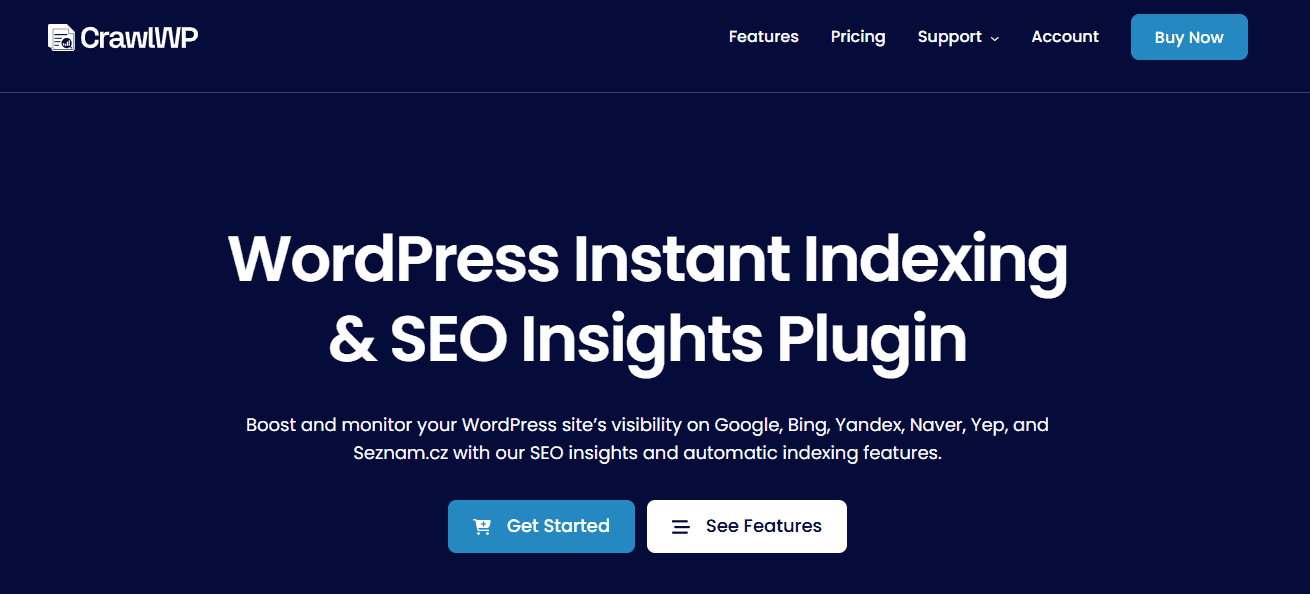
One gap that neither Ahrefs nor Majestic closes is indexing speed.
Both tools help you research and plan your link building. Neither influences how quickly Google indexes the pages those links point to.
This matters because a link pointing to an unindexed page passes no value. And a page that takes 10 to 14 days to get indexed after you publish it costs you the benefit of every link you earn in that window.
CrawlWP solves this for WordPress sites by actively notifying Google, Bing, and Yandex the moment you publish or update content. New pages get indexed in 24 to 48 hours rather than the standard 5-14-day wait.
That means every link you build through outreach, digital PR, or content promotion starts passing value faster.
The research tools show you what to build. CrawlWP ensures the pages you build are found immediately.
Start indexing your pages faster with CrawlWP →
Comparison Summary: Ahrefs vs Majestic
| Feature | Ahrefs | Majestic |
| Starting price | $29/month (Starter) | $49.99/month (Lite) |
| Professional entry point | $129/month (Lite) | $49.99/month (Lite) |
| Keyword research | Yes (extensive) | Basic only |
| Rank tracking | Yes | No |
| Site audit | Yes | No |
| Content research | Yes (Standard+) | No |
| Fresh backlink index | Yes | Yes |
| Historic backlink index | Limited | Yes (Pro+) |
| Domain authority metric | Domain Rating (DR) | Trust Flow (TF) |
| Link quality vs quantity split | No equivalent | TF/CF ratio |
| Topical Trust Flow | No | Yes |
| Clique Hunter | No | Yes (Pro+) |
| Neighbourhood Checker | No | Yes |
| Free option | Ahrefs Webmaster Tools | Limited Site Explorer |
| Free trial | No | 7-day money-back |
| Best for | All-in-one SEO platform | Specialist link intelligence |
FAQs
Is Ahrefs better than Majestic for backlink analysis?
They excel in different aspects of backlink analysis.
Ahrefs provides fresher data and surfaces new links faster, making it better for monitoring active campaigns.
Majestic provides the TF/CF ratio, Topical Trust Flow, Historic Index, and Neighborhood Checker, making it better suited to forensic link vetting, quality evaluation, and historical research.
The divergence between both tools across identical domain testing is the most useful data point: they are not interchangeable.
Can I use Majestic without Ahrefs?
Yes, if link analysis is your primary need. Majestic Lite at $49.99/month provides solid backlink data for a single site without the overhead of Ahrefs’ broader platform.
The limitation is that Majestic provides no keyword research, rank tracking, or technical auditing, so that you would need separate tools for those.
Can I use Ahrefs without Majestic?
Yes, for most SEO workflows. Ahrefs covers keyword research, rank tracking, site audits, content analysis, and backlinks on a single platform. The gaps relative to Majestic are the Historic Index for deep historical link research and the TF/CF ratio for specialist link-quality vetting. If those workflows are not central to your work, Ahrefs alone covers most needs.
Which tool is better for beginners?
Ahrefs has a more intuitive interface, comprehensive tutorials, and a range of SEO features that make it more approachable for beginners.
Majestic’s value is concentrated in specialist metrics (TF, CF, Topical TF) that require some backlink knowledge to interpret correctly.
Is Trust Flow or Domain Rating more reliable?
They measure different things.
Domain Rating measures link profile strength based on quantity and quality of referring domains. Trust Flow measures link quality via proximity to trusted seed sites. A high DR with low TF is a reliable spam signal. Using both together gives a more complete picture than either alone.
What is the main advantage of Majestic’s Historic Index?
The Historic Index provides long-term link data going back years, useful for tracking a domain’s full link history, finding lost links, and comprehensive archive analysis.
This is critical for penalty recovery, where you need to identify toxic links that may have been removed years ago, and for due diligence on expired domains.
Do SEO professionals really use both tools?
Many agencies and enterprise teams run both platforms: Ahrefs for broad SEO operations and Majestic purely for its depth of link intelligence.
This is most common at agencies where link building is a core service line, and the cost of both subscriptions is justified by the revenue from that service.
Does Majestic have keyword research?
Majestic has a basic keyword generator that shows related keywords for a domain or URL. It is not a keyword research platform like Ahrefs.
Majestic offers no site crawler, no rank tracking, no on-page SEO analysis, and no technical audit capabilities. This is a strategic focus, not an oversight.