
Learning SEO in 2026 feels like being handed a massive puzzle with pieces scattered across a hundred different websites, YouTube channels, Reddit threads, and LinkedIn posts.
Everyone has an opinion. Most of them conflict. And the advice that ranked well on Google for “how to learn SEO” was often written in 2018.
Here is something you should know: the right order to learn SEO in 2026 is different from what it used to be. Start with the official Google documentation and one comprehensive beginner’s guide. Layer in a structured course from a tool you plan to use day-to-day. Follow two or three news publications for ongoing updates.
That is the framework. This article fills in the specifics.
What makes learning SEO particularly frustrating for beginners is that the landscape genuinely changed in the last few years.
The SEO domain evolves constantly, and the last few years have brought significant changes that every beginner should understand: AI-powered search results and AI Overviews now appear for many queries, changing how users interact with search results.
Google’s helpful content system emphasizes genuine expertise and experience over keyword-stuffed content. Core Web Vitals and page experience remain critical ranking factors. E-E-A-T has become more important than ever.
So any SEO learning resource written before 2024 needs to be treated with caution. The fundamentals are mostly timeless. The tactics are often outdated.
This guide covers verified, beginner-friendly SEO learning resources that are genuinely up to date in 2026. Every resource listed here is either free or clearly marked as paid. Every feature claim is verified. Nothing is here because it paid to be here.
Here is where to start learning SEO properly.
Table of Contents
Who These SEO Resources Are For
Before the list, a quick clarity check. These resources are specifically useful if you are:
A complete beginner with no prior SEO knowledge who wants a structured starting point. A blogger, small business owner, or freelancer who needs to understand enough SEO to manage their own site. A marketing professional who wants to add SEO to their skill set. Someone who has tried to learn SEO before but got lost in contradictory advice.
If you are an advanced SEO practitioner, some of these resources will feel introductory. A few of the items on this list specifically note when they stretch into intermediate or advanced territory.
You can learn the fundamentals in 3 to 6 months of part-time study. Building the practical experience to be job-ready takes 6 to 12 months with real-world projects.
True expertise, understanding why rankings move and how to diagnose complex issues, develops over 1 to 2 years of hands-on work.
Set that expectation before you start. SEO is learnable. It is not quick.
1. Google Search Central Documentation – The Primary Source
Type: Free documentation and guides
Best for: Every beginner, no exceptions
Difficulty: Beginner to intermediate
URL: developers.google.com/search
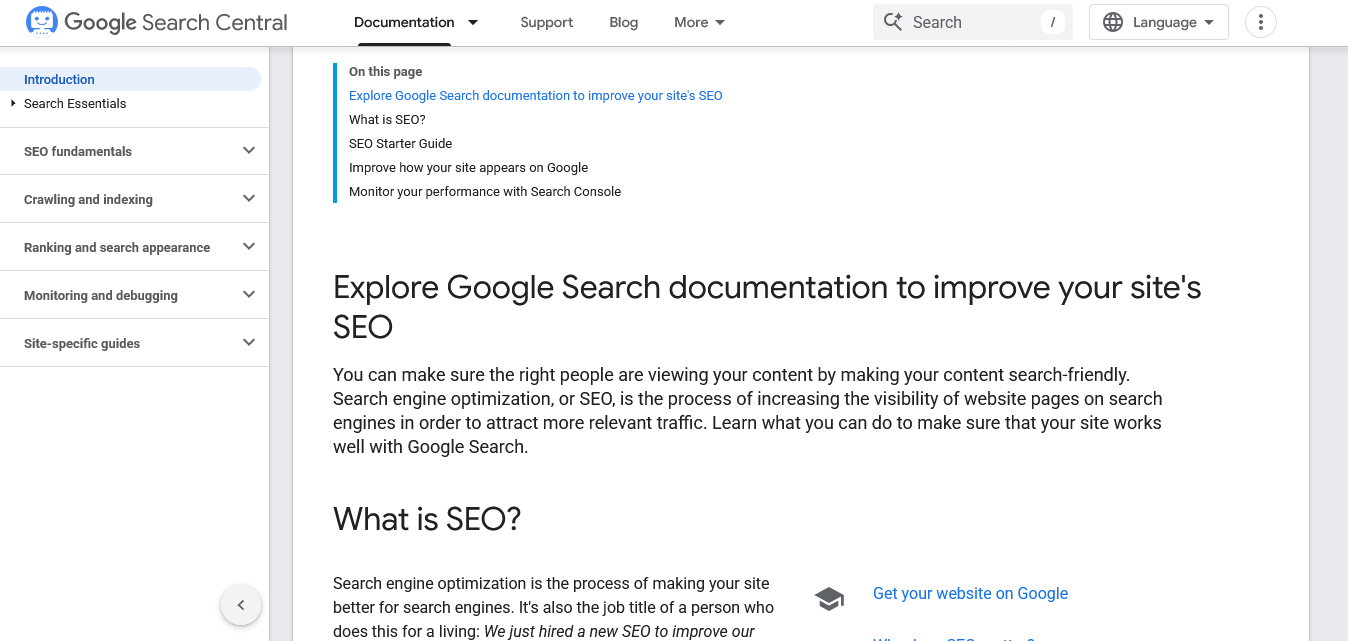
There is an obvious starting point for learning SEO and most beginners skip it: reading what Google says about SEO.
Google’s official guidelines are the ultimate source of truth for SEO best practices. Whether you are a business owner trying to increase your organic traffic or a marketing director overseeing a complex website migration, understanding Google’s official guidelines is your first step toward sustainable growth.
The SEO Starter Guide is the most important free SEO resource available in 2026. It explains, directly from Google, what SEO is, how Google’s crawling and indexing process works, what makes content eligible to appear in search, and what actually matters versus what does not.
According to Google, creating valuable, unique, non-commodity content is the single most important factor for appearing in generative AI features in search. Content that simply restates what every other site already says is unlikely to be selected.
Beyond the Starter Guide, Google Search Central covers crawling and indexing, sitemaps, robots.txt, canonical tags, structured data, Core Web Vitals, JavaScript SEO, and ecommerce SEO in separate documented sections.
The documentation was updated to include Google’s guidance on using third-party SEO tools and services, as well as guidance on evaluating SEO recommendations and tools.
What beginners often miss: the Search Central Blog, which is where Google’s Search Relations team publishes guidance on algorithm updates and new search features as they happen. Following it means you hear about significant changes directly from the source rather than through interpretations that may or may not be accurate.
What to read first:
- SEO Starter Guide (read this before anything else)
- How Google Search Works
- Search Essentials
- Search Central Blog (bookmark, check monthly)
Cost: Free
2. Moz Beginner’s Guide to SEO – The Classic That Stays Current
Type: Free written guide (10 chapters)
Best for: Complete beginners wanting a structured foundation
Difficulty: Beginner
URL: moz.com/beginners-guide-to-seo
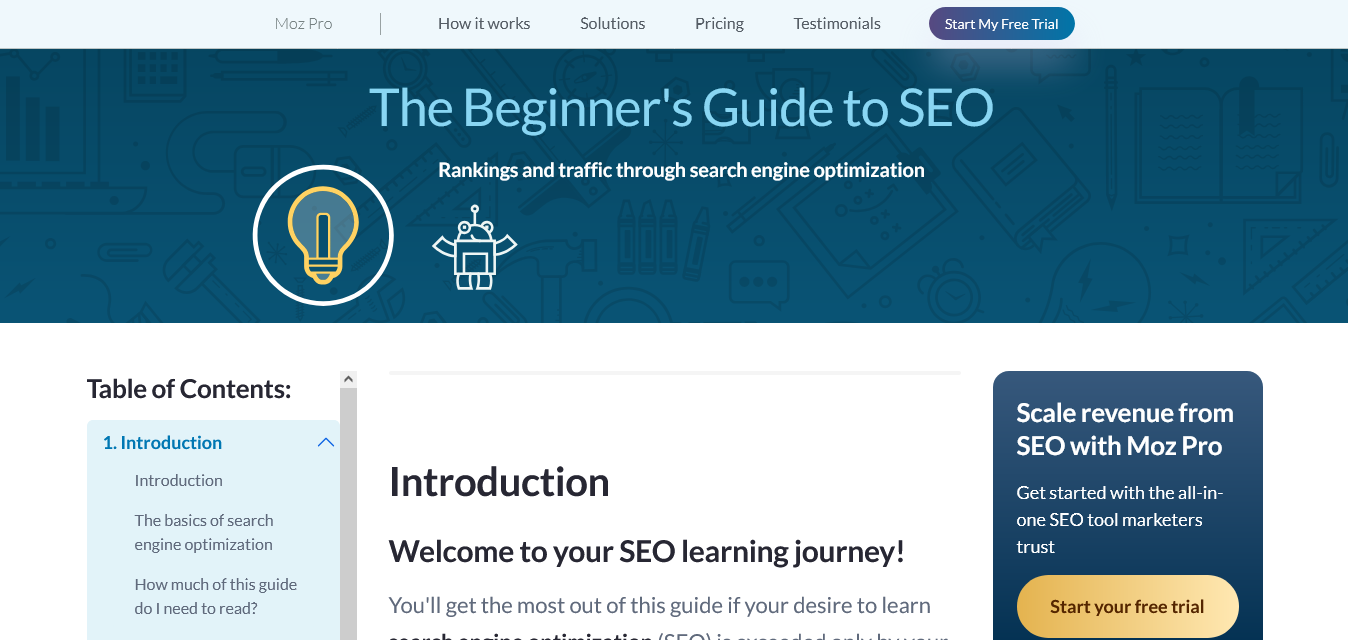
The Moz Blog is the strongest single starting point for SEO beginners, combining accessible writing, visual explanations, and a comprehensive free learning center that covers every foundational topic from keyword research to link building.
The Beginner’s Guide to SEO from Moz has trained more SEOs than any other written resource. It covers how search engines work, keyword research, on-page optimization, technical SEO, link building, and measuring results across ten structured chapters. The writing is accessible, the examples are clear, and the guide is updated to reflect current algorithm behavior rather than tactics that worked in 2015.
Moz literally wrote the Beginner’s Guide to SEO that trained a generation of SEOs. That history also means the guide carries significant credibility: the people writing it are practitioners with real data behind their recommendations.
For absolute beginners, this guide answers the question “what is SEO and how does it work” better than almost anything else available in 2026. It does not get into advanced topics like JavaScript rendering or international SEO, which is appropriate for its audience.
A note on the Moz Academy: Moz offers paid SEO courses and certifications beyond the free guide. The SEO Essentials Certification is available for those who want a credential to display on LinkedIn.
The free guide is enough for beginners to get started, and the paid courses are worth evaluating once you have worked through the free material and want to go deeper.
What to read:
- All 10 chapters of the Beginner’s Guide to SEO
- The Moz Blog for ongoing updates
Cost: Free (guide); paid certifications available separately
3. Semrush Academy – The Broadest Free SEO Course Library
Type: Free online courses with certificates
Best for: Beginners who want structured video learning with recognized certification
Difficulty: Beginner to advanced
URL: semrush.com/academy
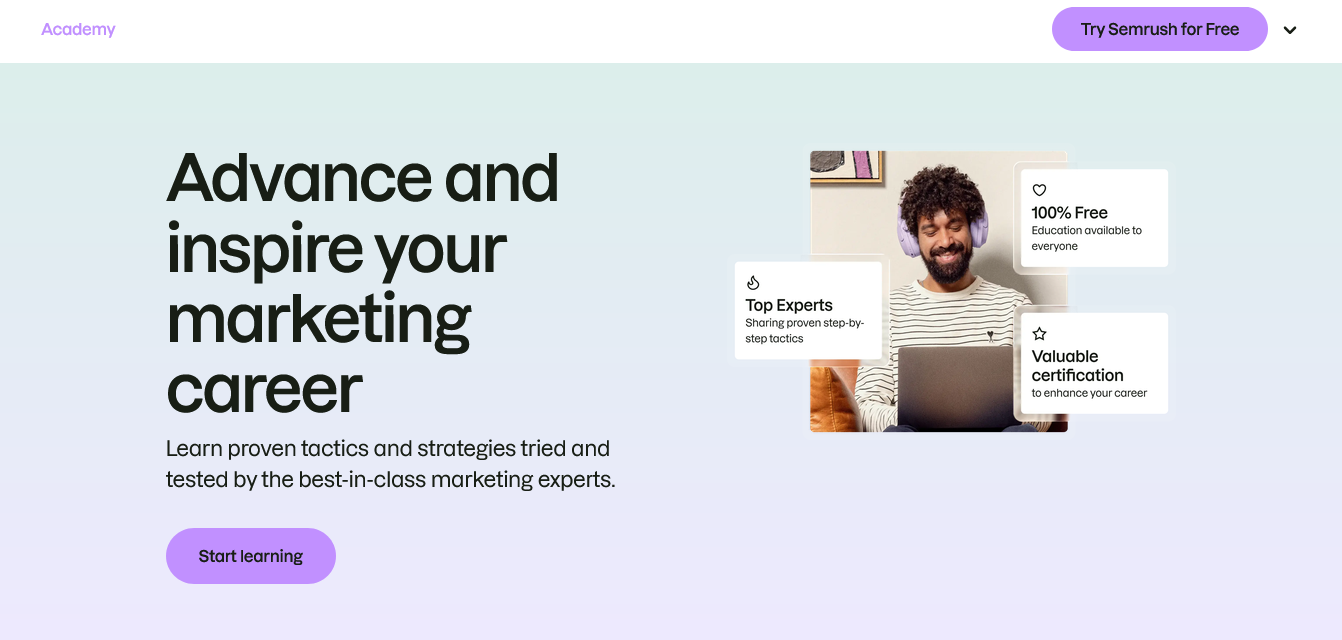
The Semrush Academy learning center is full of free digital marketing courses and certifications. The SEO-specific courses cover all aspects of modern SEO in separate courses using a modular lesson format.
Course lengths vary from 30 minutes to 4 to 5 hours, with most falling in the lower to middle part of that range.
Semrush Academy covers more SEO topics than any other single free learning platform. The library includes courses on keyword research, on-page SEO, technical SEO, link building, local SEO, content marketing, and AI search optimization.
Each course is broken into short lessons that can be completed in a single session, which works for beginners learning around a full-time job or other commitments.
Semrush acquired the SEO training specialist Backlinko in early 2022, so it features Backlinko’s Brian Dean in some of its SEO courses. The Semrush SEO Crash Course with Brian Dean is frequently cited as an excellent fast-track introduction for beginners who want a solid foundation quickly.
Certifications from Semrush Academy are free and verifiable, which makes them worth pursuing for anyone building a professional profile. They carry genuine weight in marketing job applications.
Honest note: Semrush Academy is most useful when you are comfortable learning inside the Semrush ecosystem. If your team uses another SEO platform, pair it with tool-neutral resources. The courses demonstrate concepts using Semrush’s interface, so some workflow-specific learning only applies if you use Semrush. The foundational SEO concepts are universal regardless.
Where to start:
- SEO Fundamentals Course (Semrush)
- SEO Crash Course with Brian Dean (fastest beginner overview)
- Keyword Research Essentials
Cost: Free
4. Ahrefs Academy – Practical SEO Workflows For Beginners
Type: Free online courses and tutorials
Best for: Beginners wanting practical, workflow-based SEO education
Difficulty: Beginner to intermediate
URL: ahrefs.com/academy
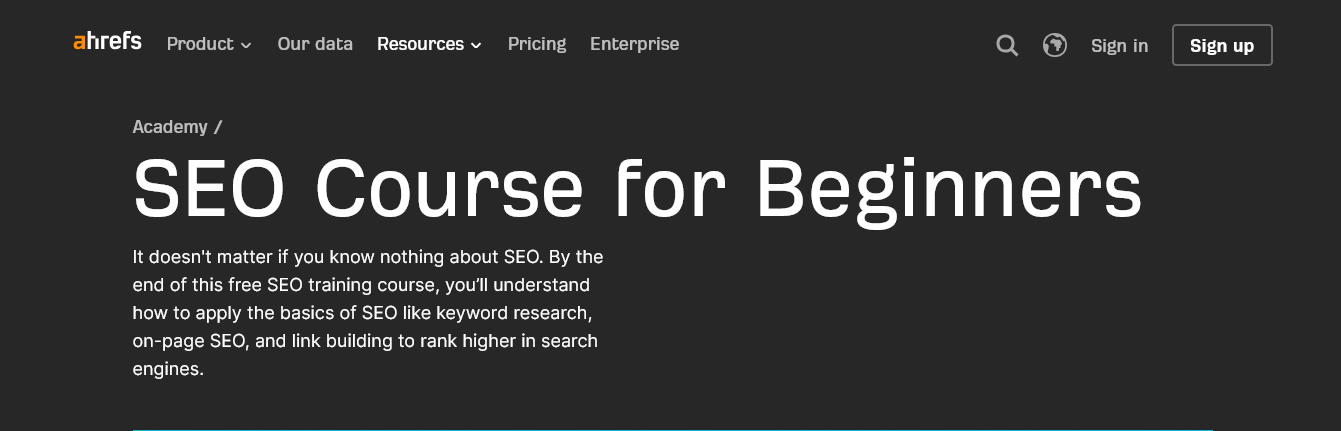
Ahrefs Academy is a free SEO training library covering keyword research, on-page and technical SEO, link building, and content, taught around real Ahrefs workflows. It is the closest free rival to Semrush Academy for practical search training.
Ahrefs Academy takes a workflow-first approach to SEO education. Rather than explaining concepts in the abstract and asking you to figure out how to apply them, courses walk through actual SEO processes using real data and real tools.
The SEO Course for Beginners is structured around what SEO practitioners actually do week to week: keyword research, content creation, on-page optimization, link acquisition, and tracking progress.
Everything is explained with practical examples from the Ahrefs software toolset. It is concise, straightforward, and ideal for anyone who wants to understand how SEO looks in practice.
The Blogging for Business course is worth noting for beginners building content-driven sites. It covers how to build an audience through SEO-focused content, which directly applies to anyone starting a blog, niche site, or content marketing program.
Both Ahrefs and Semrush Academies are strong free SEO academies. Ahrefs leans into keyword and link workflows; Semrush is broader across content, PPC, and AI search.
For beginners who want to start with keyword research and content optimization specifically, Ahrefs Academy is the sharper tool.
Where to start:
- SEO Course for Beginners (the core starting point)
- Blogging for Business (for content-driven sites)
- Keyword Research course (immediately practical)
Cost: Free
5. HubSpot Academy SEO Certification – Best For Marketing Generalists
Type: Free online course with free certification
Best for: Content marketers, small business owners, and marketing generalists
Difficulty: Beginner
URL: academy.hubspot.com
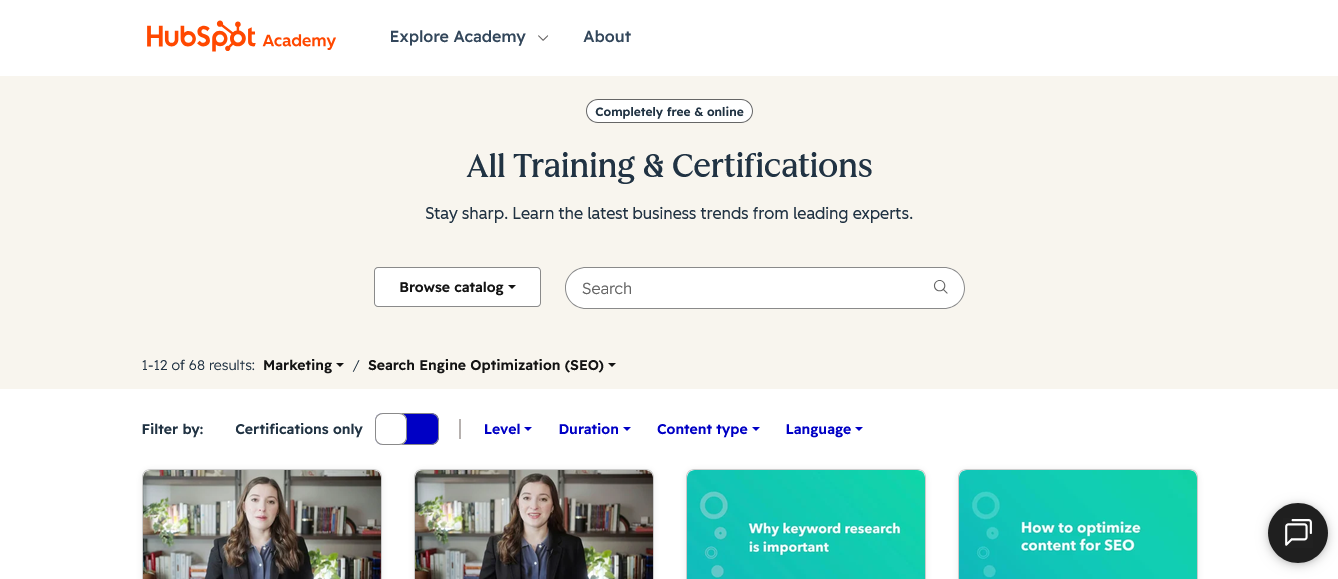
HubSpot Academy offers free SEO training that covers everything from fundamentals to advanced topics, integrated with its broader inbound marketing methodology. The courses teach SEO as part of holistic content strategy rather than isolated tactics. Certificates are free and can be displayed on LinkedIn profiles.
The HubSpot SEO Certification is structured as short modules covering keyword strategy, on-page optimization, technical SEO fundamentals, link-building basics, and measuring SEO performance. The total time investment is approximately 3 hours and 50 minutes, making it achievable in a single focused day or spread across a week for learners with limited time.
For most beginners, the HubSpot SEO Certification Course offers the best combination of depth, a recognized certification, and practical application. Its structured content covers the full SEO stack without requiring any prior technical knowledge, and the HubSpot name carries real weight in marketing hiring contexts.
The difference between HubSpot Academy and purely SEO-focused academies like Ahrefs or Semrush is the context. HubSpot frames SEO as part of an integrated content marketing and inbound strategy, which is genuinely useful for beginners who will need to connect SEO decisions to broader marketing goals. For a business owner or content marketer rather than a dedicated SEO specialist, that context is valuable.
The integration of SEO with broader content strategy teaches you to think holistically rather than just chasing rankings. That shift in thinking matters more for long-term success than most tactical advice.
Honest note: Some content is HubSpot-tool-centric. The courses are good but less deep than comprehensive paid alternatives. Best for generalist marketers, not SEO specialists.
Cost: Free (including the certification)
6. LearningSEO.io – Free SEO Learning Roadmap
Type: Free curated learning roadmap.
Best for: Self-directed learners who want a structured path through existing free resources.
Difficulty: Beginner to advanced.
URL: learningseo.io
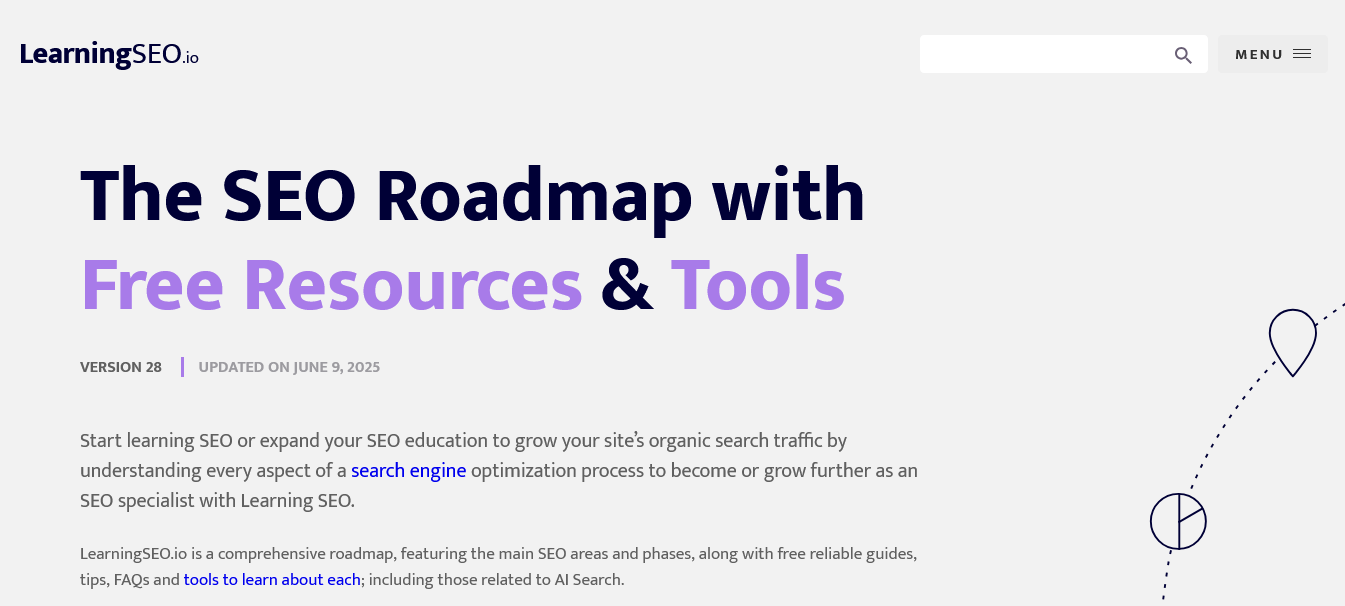
LearningSEO.io is not a course in the traditional sense. It is a free and evolving SEO learning roadmap curated by experts.
It covers everything from fundamentals, including keyword research, on-page, and technical SEO, to advanced topics including site audits, CMS-specific optimization, link building, SEO process, SEO automation, and niche-oriented SEO. As it is a collection of resources rather than a linear course, time to complete depends on how deeply you decide to go.
This flexibility makes it a good fit for part-time learners or those who want to explore at their own speed.
LearningSEO.io was created by Aleyda Solis, one of the most respected SEO consultants in the industry. The roadmap is visually organized as a series of interconnected nodes, each representing an SEO topic, with each node linking to the best available external resource for learning that topic.
LearningSEO.io is the closest thing to a syllabus you will find for free SEO education. Each node in the roadmap links to a specific external resource, whether Google documentation, a Moz guide, an Ahrefs guide, or something else, which means the site itself is not teaching you. It points you to the best available teacher for each topic.
For beginners who find it overwhelming to decide which resource to use for which topic, this is the answer. Rather than searching the web and finding a mix of current and outdated content, LearningSEO.io curates the best verified resource for each piece of SEO knowledge.
It is also maintained and updated as better resources emerge or older ones go stale.
This resource works best when used alongside a structured course. Complete the Semrush or HubSpot Academy course first to build your foundation, then use LearningSEO.io to guide where you go deeper.
Cost: Free
7. SEOFOMO Newsletter – The Highest Signal Weekly SEO Update
Type: Free weekly email newsletter
Best for: Beginners who want to stay current without spending hours following SEO news
Difficulty: Accessible for beginners, valuable at all levels
URL: seofomo.co
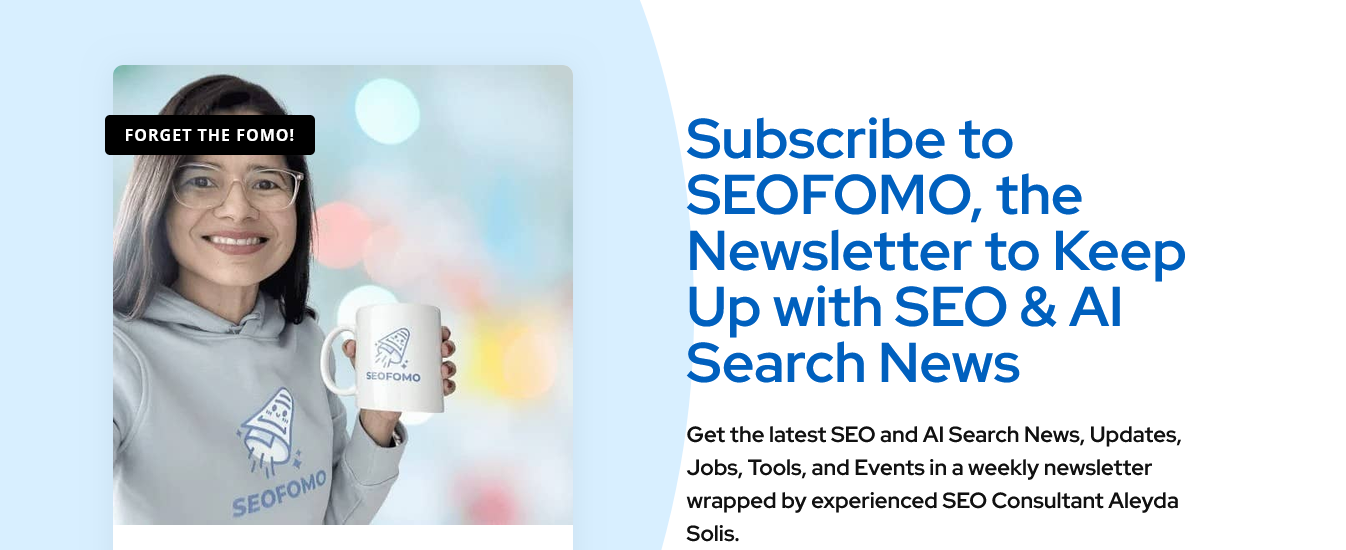
If you only follow one SEO newsletter, make it SEOFOMO. Aleyda Solis curates the week’s most important SEO news, resources, jobs, and events and sends it to 35,000-plus subscribers every Sunday.
Notable for the quality of curation: she actually reads everything and picks only what is worth your time. Subscribing to SEOFOMO is probably the single highest-ROI SEO-learning action you can take in 2026.
Most SEO newsletters either bury you in tactical minutiae or publish vague “SEO is changing” content that tells you nothing specific. SEOFOMO sits in a genuinely different category. Each edition covers significant Google updates, new research, useful tools, industry conversations worth following, and job opportunities in the field.
Aleyda Solis was named European Search Personality of the Year in 2018 and is also the maker of LearningSEO.io, LearningAIsearch.com, and the host of the Crawling Mondays video and podcast series.
Her newsletter reflects the same curation quality as her learning roadmap: she filters the noise so you do not have to.
For beginners who cannot spend two hours a week reading SEO news, a 10-minute Sunday read through SEOFOMO keeps you current on the changes that actually matter.
Over time, recognizing which updates are significant and which are noise is itself a valuable skill that the newsletter helps develop.
Cost: Free
8. Backlinko – The Best SEO Blog For Practical Beginner Guides
Type: Free SEO blog and guides
Best for: Beginners who learn through in-depth guides with real case studies
Difficulty: Beginner to intermediate
URL: backlinko.com
Backlinko is one of the most consistently useful SEO blogs for beginners. The site was built by Brian Dean, who created the Skyscraper Technique and several other widely adopted SEO frameworks.
Semrush acquired Backlinko in 2022, and the content quality has remained strong through that transition.
Backlinko features powerful resources for keyword research, backlink analysis, and website optimization. The guides are long, detailed, and built around real case studies with specific results.
The approach is to show why something works by showing data from campaigns that actually ran, rather than explaining theory without connecting it to outcomes.
For beginners, the most useful starting points on Backlinko are the SEO fundamentals guides covering keyword research, on-page optimization, technical SEO, and link building.
Each guide is comprehensive enough to serve as a standalone resource on its topic, yet accessible to someone with no prior SEO knowledge.
Brian Dean built Backlinko to over five million monthly readers before selling it and has been featured in Forbes, Entrepreneur, and TechCrunch as an SEO reference. Instructor credibility is a reliable proxy for content quality.
That credibility matters when you are evaluating which SEO advice to trust.
Where to start on Backlinko:
- How to Learn SEO (practical framework for building skills quickly)
- Keyword Research: The Definitive Guide
- On-Page SEO: The Definitive Guide
- Link Building for SEO
Cost: Free
9. CrawlWP – SEO Tool That Teaches Through Doing
Type: Free WordPress plugin with paid Pro tier
Best for: WordPress site owners who want to learn SEO by watching real search performance data
Difficulty: Beginner
URL: crawlwp.com
Every resource on this list so far teaches SEO through reading, watching, or structured courses. CrawlWP teaches SEO through something more valuable for practical learners: watching your own site’s actual search performance in real time.
Most beginner SEO learners face a particular frustration. They study keyword research, on-page optimization, and technical SEO carefully. They publish content. Then they wait.
They have no idea whether Google found the page, whether it started ranking, which keywords it might appear for, or whether anything they did made a difference. That feedback gap makes learning SEO feel abstract and disconnected from results.
CrawlWP closes that gap for WordPress sites. The plugin connects directly to Google Search Console, Bing Webmaster Tools, and Yandex using official APIs and displays your actual search performance data inside your WordPress dashboard. You see clicks, impressions, CTR, and average position per keyword and per page, all from the source, without logging into separate platforms.
Why this matters for learning SEO as a beginner:
When you publish a post optimized for a specific keyword and then watch CrawlWP’s Top Keywords report show that keyword gaining impressions over the following weeks, SEO becomes observable and tangible.
When CTR sits at 0.5% for a page with 5,000 monthly impressions, you have a concrete, specific problem to solve: the title tag or meta description is not compelling enough to earn clicks. Working through that problem teaches on-page optimization more effectively than reading about it.
The Bing Stats feature shows daily performance data from Bing, including ranking keywords and page-level traffic. For beginners who have never considered search engines beyond Google, seeing that Bing drives real traffic to sites, particularly through Microsoft Copilot, DuckDuckGo, and Yahoo, expands understanding of the search landscape.
The SEO email reports feature automatically sends weekly or monthly performance summaries, so beginners can track their progress without having to remember to log in. Those reports create a regular rhythm of reviewing performance and identifying what to work on next.
Beyond reporting, CrawlWP actively submits your content to Google, Bing, and Yandex the moment you publish, cutting indexing time from 5 to 14 days down to 24 to 48 hours.
For a beginner who wants to see results from their SEO work quickly, that acceleration matters. Faster indexing means faster feedback, which means faster learning.
Thousands of WordPress site owners use CrawlWP to monitor and improve their search performance. The free version covers core SEO stats reporting across all three search engines.
Pro adds auto-indexing, bulk index submissions, email performance reports, advanced analytics, and priority support.
What beginners learn by using CrawlWP:
- What impressions vs clicks vs CTR actually mean, from their own data
- Which keywords their pages naturally start ranking for
- How title and meta description changes affect CTR in practice
- Why Bing and Yandex matter as traffic sources
- How indexing works and how to accelerate it
Cost: Free (Pro at $59/year)
Start tracking your SEO performance with CrawlWP →
How To Build Your SEO Learning Path In 2026
With nine resources in front of you, the natural question is where to start and in what order.
Here is the sequence that makes the most sense for most beginners:
Week 1 to 2: Foundation
Read Google Search Central’s SEO Starter Guide first. Then read Moz’s Beginner’s Guide to SEO. Both are free. Both are current. Both answer the question “how does SEO actually work” before you touch any tools or tactics. Set up Google Search Console on your site during this phase so you have a real data source to reference as you learn.
Week 3 to 4: Structured course
Complete either the Semrush Academy SEO Fundamentals course or the HubSpot SEO Certification, depending on whether you prefer a broader marketing context (HubSpot) or a more SEO-specific focus (Semrush). Both take under four hours and leave you with a certificate worth displaying.
Week 5 to 6: Practical application
Install CrawlWP and use LearningSEO.io to identify which specific SEO topics you want to go deeper on based on what you found most challenging in the course. Apply what you learned to your actual site and watch the data in CrawlWP to see what changes.
Ongoing:
Subscribe to SEOFOMO for weekly updates. Use Ahrefs Academy and Backlinko for deep-dive guides on specific topics as you need them. Return to Google Search Central whenever you need to verify whether a specific tactic is actually supported by Google’s guidelines.
Skip most of the ten-year-old guides that still rank for “learn SEO” queries, because the tactics they recommend are often obsolete. When you find a guide through search, check the date and check who wrote it before following any advice.
FAQs
How long does it take to learn SEO as a beginner?
You can learn the fundamentals in 3 to 6 months of part-time study. Building the practical experience to be job-ready takes 6 to 12 months with real-world projects. True expertise, understanding why rankings move and how to diagnose complex issues, develops over 1 to 2 years of hands-on work.
Set realistic expectations and prioritize applying what you learn to a real site as early as possible.
What is the best free resource to learn SEO for beginners?
Google Search Central’s SEO Starter Guide is the most authoritative starting point because it comes directly from Google. For a more structured beginner experience, the Moz Beginner’s Guide to SEO covers the same territory with more hand-holding and visual explanations.
Using both together covers the foundation comprehensively without spending anything.
Do I need paid SEO tools to learn SEO?
No. Google Search Console, CrawlWP’s free tier, Google Analytics, and Google Search Central are all free and together provide everything a beginner needs to learn and practice SEO on a real site.
The free courses from Semrush Academy, Ahrefs Academy, and HubSpot Academy are genuinely free, with no paywall. Paid tools become worth evaluating once you have exhausted what the free options can teach you.
Is SEO still worth learning in 2026 with AI search growing?
Yes.
Organic search still drives roughly 53% of all website traffic globally. Google made approximately 4,781 changes to its search system in a single year.
The skills that make content rank in traditional search, covering topics thoroughly, demonstrating genuine expertise, and building site authority, are the same skills that make content appear in AI Overviews and AI search citations. SEO expertise transfers directly to the AI search era.
Which SEO certification is most recognized by employers?
The HubSpot SEO Certification Course provides the best combination of depth, recognizable certification, and practical application. The HubSpot name carries real weight in marketing hiring contexts.
Semrush Academy certifications are also widely recognized. For the most credible academic certification, UC Davis offers a Google SEO Fundamentals course on Coursera that carries university credentials.
Should I learn technical SEO as a beginner?
Learn enough technical SEO to understand how crawling and indexing work, how to use Google Search Console to identify errors, and how to implement basic fixes. You do not need to understand JavaScript rendering or advanced server configuration to start getting results from SEO.
Build foundational knowledge first, then go deeper on technical SEO once you have the context to understand why it matters.
How do I stay up to date on SEO changes as a beginner?
Subscribe to SEOFOMO, curated weekly by Aleyda Solis and sent to 35,000-plus subscribers every Sunday. Bookmark Google Search Central’s What’s New page for official algorithm and documentation updates.
Follow Search Engine Journal and Search Engine Land for news coverage. As a beginner, one newsletter and one news source is enough. More than that creates noise rather than signal.
What is the biggest mistake beginners make when learning SEO?
Following outdated advice.
Skip most of the ten-year-old guides that still rank for “learn SEO” queries, because the tactics they recommend are often obsolete.
Always check the date on any SEO guide before following its recommendations. A guide from 2019 may still be partly accurate on fundamentals but significantly wrong on tactics that Google has since updated its position on.